
Left Turn Accidents in Texas – Whose Fault is it?
In Texas, the driver making a left turn is often presumed to have the duty to yield to oncoming traffic. But fault is not automatic. A left-turn crash may also involve speeding, red-light violations, distracted driving, poor visibility, or shared fault. This guide explains how fault is determined in Texas left-turn accidents, what evidence matters, and when an injured person may still recover compensation.
If you were seriously hurt, our Houston auto accident lawyer page explains the broader claims process, evidence, and next steps after a crash.
Understanding Left Turn Accidents
Left-turn accidents typically occur when a driver attempts to turn left at an intersection and collides with an oncoming vehicle. These accidents can happen for various reasons, including misjudgment of the oncoming vehicle’s speed, failure to yield the right of way, distracted driving, or impaired or drunk driving.
Determining fault in a left-turn accident requires careful analysis of the collision’s circumstances.
Who Is Usually at Fault in a Left-Turn Accident in Texas?
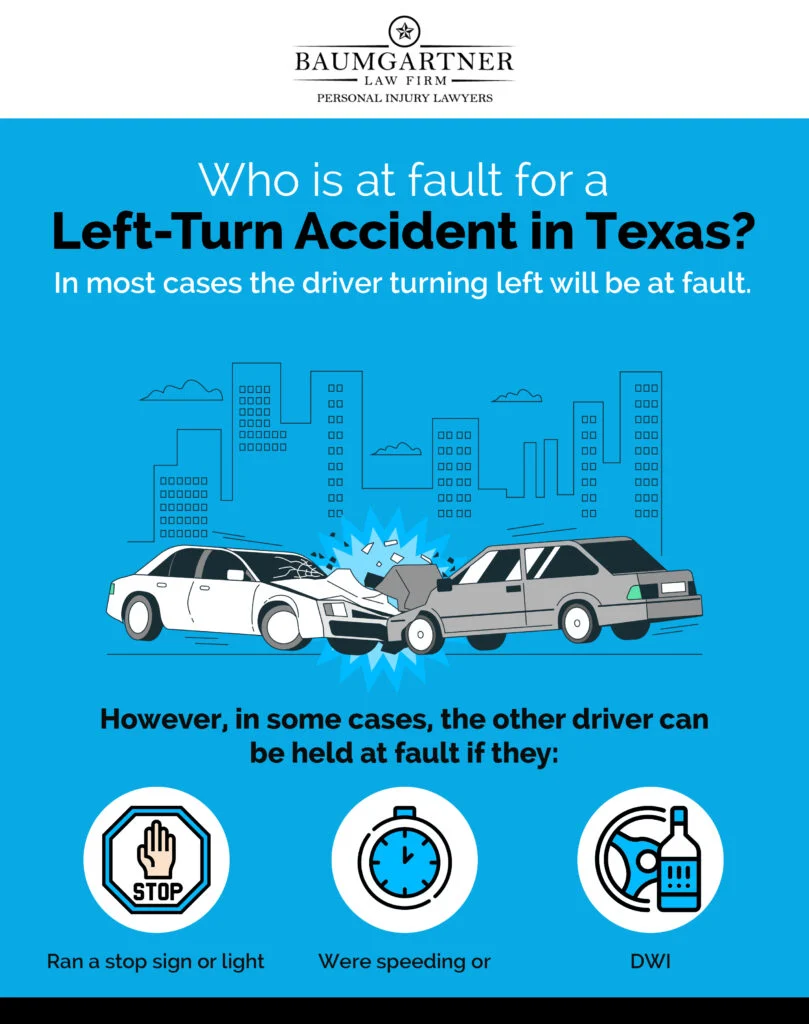
In most cases, the driver making the left turn is considered at fault for the auto accident. This is because they must yield the right-of-way to oncoming vehicles. However, there are exceptions to this general rule.
If liability is disputed, our guide to determining fault in a Houston car accident explains how police reports, witness statements, photos, and other evidence are used to assign blame.
If the driver making the left turn can prove that the oncoming vehicle was speeding, ran a red light, or was otherwise negligent, they may be able to shift the blame to the other driver. Additionally, weather conditions, obstructed views, or mechanical failures of either vehicle can also impact fault determination.
Oncoming traffic and driving faster than the speed limit are common factors contributing to left-hand turn accidents. The driver turning left may not be aware of how fast the cars are going when they make a left-hand turn.





What Texas Law Says About Left Turns and Right of Way
Under Texas law, a driver turning left must yield the right of way to oncoming traffic that is already in the intersection or close enough to be an immediate hazard. That is why the left-turning driver is often blamed first. But liability is not automatic. If the oncoming driver was speeding, ran a red light, was distracted, or otherwise acted negligently, fault may be shared or shifted.
When the Left-Turning Driver May Not Be Fully at Fault
In many Texas left-turn crashes, the driver making the turn is blamed first because that driver usually has a duty to yield to oncoming traffic. However, the turning driver is not always entirely responsible. Real-world crashes are often more complicated, and fault may be shared.
Pro Tip: The turning driver may not always bear full responsibility in left-turn crashes.
For example, the oncoming driver may have been speeding, distracted, or trying to beat a red light. Sometimes, the oncoming vehicle may not have had its headlights on at night, making distance and speed harder to judge. Other factors may include poor intersection design, traffic backups, or another driver waving someone through unsafely. Key takeaway: Several factors beyond the turning driver’s actions may contribute to a left-turn crash.
There are also left-turn accidents where both drivers made mistakes. For instance, a turning driver may misjudge the gap, while the other driver may be speeding or entering the intersection after the light changes. In these situations, fault may be shared. Under Texas law, the turning driver must yield to an oncoming vehicle that poses a hazard, but specific facts matter.
Pro Tip: Both drivers can share responsibility in left-turn crashes.
Related Links
Our Experienced Personal Injury Lawyer Can Help!
Case Results
$5,750,000.00 Truck Accident - Wrongful Death
$6,000,000.00 Daycare Injury
Confidential Settlement Commercial Vehicle Crash - Wrongful Death
Confidential Settlement Burn Injury
Confidential Settlement 18-Wheeler Accident - Wrongful Death
Common Causes of Left-Turn Accidents
Left-turn accidents happen for many reasons, often tied to poor visibility, timing, or unsafe driving by one or both parties. Frequently, a driver simply misjudges an oncoming vehicle’s speed or distance.
Pro Tip: Misjudgment is a major cause of left-turn crashes.
Distracted driving is another common factor. Drivers looking at phones, talking, or distracted may fail to see or properly check for oncoming vehicles. Speeding also reduces reaction time for both drivers.
Signal confusion also plays a role. Crashes happen when a driver turns left on a solid green instead of a green arrow, or when someone rushes a yellow or runs a red light. Weather, blocked views, large vehicles, and heavy traffic can reduce visibility and pressure quick decisions.
What Evidence Helps Prove Fault in a Left-Turn Crash
The strongest left-turn accident claims are built on evidence. Even when the blame appears clear, insurance companies may try to shift it. The evidence collected after a crash is crucial to proving your case. If liability is being disputed, the same kinds of car accident evidence used in serious Houston collision claims can make the difference in a left-turn case.
Pro Tip: Collecting strong evidence is essential for left-turn accident claims.
The police crash report is a key starting point, identifying collision location, directions, and any citations. Photos of vehicles, intersections, skid marks, debris, and signals can show how the crash happened. Witness statements are useful, especially if drivers give conflicting accounts.
Video is often even more valuable. Dash-cam, surveillance, and intersection footage can show if someone ran a light, turned too soon, or sped.
Sometimes, vehicle data or phone records help reveal pre-crash events.
In left-turn crashes, small details frequently matter. The point of impact, the vehicles’ resting positions, and the timing of the traffic signal can all help determine whether the turning driver failed to yield or whether the other driver also contributed to the crash.
How Comparative Fault Works in Texas
Texas does not always treat car accidents as all-or-nothing. The system allows more than one person to share fault for a crash, based on the facts. Key takeaway: Fault can be apportioned among parties in Texas crash cases.
In a left-turn accident, one driver may be blamed for turning across traffic, while the other may be blamed for speeding, running a red light, or being distracted. If both contributed, the fault is divided according to their respective percentages. A partly at-fault person can recover damages in Texas unless they are more than 50 percent at fault. Recovery is reduced by their share of fault.
This issue matters because insurance companies often try to use comparative fault to lower the value of a claim. They may argue that the injured driver failed to keep a proper lookout, turned too soon, or could have avoided the crash. In serious cases, fault disputes can become a major issue in the claim. That is one reason why evidence is so important after a Houston left-turn collision.
What to Do After a Left-Turn Accident in Houston
The first priority after a crash is safety. Call 911 if there are injuries and report the accident. If possible, gather photos, note evidence, and collect witness information. Key takeaway: Act quickly to collect evidence and contact authorities.
Seek medical care as soon as possible, even if injuries seem minor. Some injuries take time to surface, and prompt care protects your health and claim. Be cautious with statements to the other driver’s insurer—a quick comment can be used against you in disputed-fault cases.
Because left-turn crashes often involve right-of-way disputes, gather and preserve evidence as soon as possible. This includes photos, witness details, reports, and any video footage. If fault is disputed, a Houston car accident lawyer can review the case and address insurance arguments.
Pro Tip: Early evidence preservation and legal help are key in disputed left-turn cases.
Related Resources:
Contact the Personal Injury Lawyer
at Baumgartner Law Firm for Help!
Contact the Houston left-turn accident or other injury case law firm for help with a personal injury claim.
OR
Fill out an online consultation request for a FREE consultation.
About Our Law Firm in Houston
Houston personal injury lawyer Greg Baumgartner heads the Baumgartner Law Firm.
Our firm was established in 1985 and has helped thousands of injury victims get maximum compensation for their cases. If you have been injured in an accident in Houston, TX, contact us for a free, no-obligation consultation. (281) 587-1111.
Baumgartner Law Firm has limited its law practice to serious personal injury and wrongful death claims. Our legal team has won maximum compensation for thousands of accident victims and recovered millions of dollars for real people like you.