
Houston Uber Accident Lawyer
- 40+ years handling serious injury claims
- Direct access to Greg Baumgartner
- Trial-ready representation
- No fee unless recovery
- Focused on serious injury and wrongful death cases


Written and legally reviewed by Greg Baumgartner, Houston Personal Injury Attorney
Founder & Lead Trial Lawyer, Baumgartner Law Firm · 40+ Years of Trial Experience · Trial Lawyers College Graduate · AVVO 10/10 Rating
Last reviewed and updated: July 4, 2026,
Hurt in an Uber accident in Houston? You may be dealing with Uber, the Uber driver, another driver, and several insurance companies at the same time. Each one may try to shift blame or limit what it pays.
Baumgartner Law Firm helps seriously injured Uber passengers, drivers, pedestrians, and people in other vehicles identify the right insurance coverage and protect their claims. You work directly with attorney Greg Baumgartner, who has handled serious injury cases in Houston for more than 40 years.
Your consultation is free. You pay no attorney’s fee unless we recover money for you.
Quick Answer: If you were hurt in a Houston Uber accident, the insurance coverage depends on the Uber driver’s app status. If the driver had accepted a ride or had a passenger in the vehicle, Uber’s $1 million policy may apply. If the driver was logged in and waiting for a ride request, lower contingent coverage may apply. A Houston Uber accident lawyer can help preserve app data, identify all available insurance, and deal with the insurers before evidence disappears.
For a FREE Consultation Contact Us Today
"*" indicates required fields
How Common Are Uber Accidents in Houston?
Uber accidents happen often in Houston because rideshare traffic overlaps with some of the city’s busiest crash corridors. Houston had more than 66,000 crashes in 2024, according to Texas Department of Transportation data, and rideshare drivers spend much of their time in high-traffic areas.
Uber activity is heavy on I-10, I-45, US-59/I-69, Loop 610, Westheimer, Midtown, Downtown, the Galleria, the Medical Center, and airport routes. These areas create real risks: sudden pickups, quick lane changes, distracted app use, late-night rides, and stop-and-go traffic.
Where the accident occurred matters. It can affect which police agency prepared the report, whether traffic or business camera footage exists, and where a lawsuit may be filed.
Why Are Uber Accident Claims More Complicated Than Regular Car Accidents?
Uber claims are more complicated because insurance coverage depends on what the driver was doing in the app at the time of the crash. While an Uber driver may be held liable, several insurers may point fingers at one another over payment. Uber calls its drivers independent contractors, which shields the company from most direct lawsuits.
In a normal wreck, accident victims file a claim with one driver and one insurance company. In an Uber wreck, you might deal with three: the driver’s personal insurer, Uber’s commercial insurer, and your own. Each one has a reason to say the other should pay.
Then there’s the contractor problem. Because drivers aren’t Uber employees, suing Uber directly is hard. Most claims run through the insurance policies instead. That makes one fact more important than any other: which coverage phase applied when you crashed. A lawyer who handles Uber and Lyft accident cases every day knows how to pin that down fast.
How Does Uber’s Insurance Coverage Work in Texas?
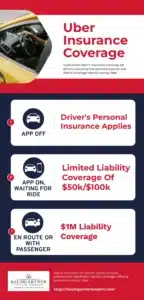
Uber’s insurance in Texas works in three phases. App off: only the driver’s personal policy applies. App on, waiting for a ride: Uber provides $50,000 per person, $100,000 per crash, and $25,000 for property damage. Ride accepted or passenger on board: Uber’s $1 million policy applies.
These aren’t just company rules. Texas law sets them. Texas Insurance Code Chapter 1954 requires this exact coverage for every rideshare company in the state, and Uber confirms the $1 million policy on its own safety page. Here’s the practical version:
- Phase 0 — App off. The driver is just a regular driver. Only their personal auto policy applies, and Texas minimum coverage is often just $30,000 per person.
- Phase 1 — App on, no ride yet. Uber’s contingent coverage kicks in: $50,000 per person, $100,000 per crash, $25,000 in property damage. Many personal policies exclude this window entirely.
- Phase 2 and 3 — Ride accepted through drop-off. Uber’s $1 million commercial policy covers the trip. Uninsured motorist coverage applies here, too.
The fights almost always happen at the phase lines. Was the driver logged in? Had they accepted the ride? App data answers those questions — and Uber won’t hand it over just because you ask nicely. We know how to get it.
Why Choose Baumgartner Law Firm for My Houston Uber Accident Case?
When you hire Baumgartner Law Firm, you work directly with Greg Baumgartner. Your case is not handed off to a junior lawyer or treated like a number.
Greg has represented seriously injured Texans for more than 40 years. He investigates the crash, reviews the insurance issues, leads negotiations, and prepares the case for trial when the insurer will not pay fairly.
Why clients in Texas and across Harris County choose Baumgartner Law Firm:
- Direct access to Greg Baumgartner
- 40+ years handling serious injury and wrongful death cases
- Selective case intake focused on serious injury claims
- Trial-ready approach when insurers deny fault or minimize injuries
- Experience with commercial insurance issues that often appear in rideshare claims
- Houston-based knowledge of local crash evidence, courts, and claim handling
Large firms often market the credentials of a senior lawyer while other people handle the file. Our approach is different. Serious cases deserve direct attention from a leading attorney. See our client results.




Injured in an Uber Accident? Call Baumgartner Law Firm
Call our Houston Uber Accident Attorneys at (281) 587-1111 to schedule a free, confidential consultation today.
Call Now (281) 587-1111Who Can Be Held Responsible for Your Houston Uber Accident?
Several parties may be responsible for a Houston Uber accident. The answer depends on who caused the crash and which insurance coverage applies.
Possible responsible parties include:
- The Uber driver, if careless driving caused the crash
- Another driver, if that driver hit the Uber vehicle
- More than one driver, if both contributed to the wreck
- Uber’s commercial insurance carrier, if the ride was active or the driver was logged in
- A vehicle or parts manufacturer, if a defect caused or worsened the crash
- A government body, in rare cases, involving a dangerous road condition
This matters because serious injuries often require more than one insurance policy. For example, if a commercial truck hits your Uber, a trucking policy may apply. If the at-fault driver has no insurance, an uninsured motorist claim may help fill the gap.
Types of Uber Accident Cases We Handle
Uber accident claims are not all the same. The type of crash affects fault, insurance coverage, available evidence, and case value. Baumgartner Law Firm handles serious Uber accident cases involving:
- Injured Uber passengers
- Uber drivers hit by another careless driver
- Drivers and passengers in other vehicles hit by an Uber driver
- Pedestrians hit by an Uber vehicle
- Bicyclists injured by an Uber driver
- Airport pickup and drop-off crashes
- Multi-vehicle Uber accidents
- Drunk, distracted, or fatigued Uber driver crashes
- Rear-end, intersection, and highway Uber crashes
- Uber accidents involving uninsured or underinsured drivers
The first question is usually simple: who caused the crash? The next question is often harder: which insurance policy applies? We focus on both from the start.
Evidence That Can Help Prove Your Uber Accident Claim
Uber accident claims often turn on app-based proof. Save anything that shows the ride was active, who the driver was, where the trip started, where it ended, and what happened after the crash.
Important evidence may include:
- Uber trip receipt
- Screenshot of the driver’s name, photo, and vehicle information
- Route map and pickup/drop-off details
- In-app crash report or Safety Toolkit report
- Police crash report number
- Photos of the vehicles, road, traffic signals, and injuries
- Names and phone numbers of witnesses
- Dashcam footage or rideshare camera footage
- Nearby business or intersection camera footage
- Medical records and bills
- Lost wage records
- Insurance letters or claim numbers
- Text messages or emails from Uber, the driver, or any insurer
Do not delete the Uber app, trip receipt, photos, or messages. A lawyer can send preservation letters to help protect app data, video, and insurance records before they disappear.
How to get a police report: HPD-worked crashes → buy the report through TxDOT’s Crash Report Online Purchase System or HPD’s Records Division; suburb crashes may belong to the Harris County Sheriff’s Office.
How Much Is a Houston Uber Accident Case Worth?
The value of a Houston Uber accident case depends on the injuries, medical bills, lost income, pain, future care, fault, and available insurance. There is no honest average settlement number that applies to every Uber crash.
The biggest case value factors are:
- How serious the injury is
- Whether surgery, hospitalization, or long-term treatment is needed
- Whether the injury affects work, mobility, memory, or daily life
- The amount of past and future medical care
- Lost income and reduced earning ability
- Pain, suffering, mental anguish, and impairment
- Whether the Uber driver had accepted a ride or had a passenger in the vehicle
- Whether the $1 million Uber policy applies
- Whether another driver shares fault
- Whether UM/UIM coverage is available
- Whether the insurer disputes liability or damages
Minor injury claims may resolve for far less than cases involving surgery, brain injury, spinal injury, permanent impairment, or wrongful death. The right way to value an Uber accident claim is to review the facts, identify all insurance coverage, document the full harm, and prepare the case as if the insurer may force litigation.

Contact Us
FREE CONSULTATIONS
Contact the Accident Attorney in Houston with Decades of Expertise and a Proven Track Record.
What Are the Most Common Injuries in Houston Uber Accidents?
The most common Uber accident injuries include whiplash, broken bones, back and neck injuries, concussions, spinal cord injuries, internal bleeding, and soft tissue damage. Serious crashes can also cause traumatic brain injuries, surgery-level orthopedic injuries, paralysis, burns, or death.
Uber passengers may be badly hurt because they often sit in the back seat, may have less airbag protection, and rarely see the crash coming. Some injuries do not feel serious at first. That is why prompt medical care matters even if you think you are only sore.
In serious injury cases, the settlement must cover more than the initial emergency room bill. Future treatment, lost income, pain, impairment, and the way the injury changes daily life all matter.
What Compensation Can You Recover After an Uber Accident?
Every case is different. The goal is to identify every loss caused by the crash and every insurance policy that may pay for it. Serious Uber accident claims should account for future care and long-term effects, not just the bills that have already arrived.
Type of compensation | Examples |
Medical expenses | Ambulance, ER care, hospital bills, surgery, therapy, medication, future treatment |
Lost income | Missed work, reduced earning ability, lost business income, missed opportunities |
Pain and suffering | Physical pain, sleep loss, stress, anxiety, loss of enjoyment of life |
Long-term harm | Disability, impairment, scarring, disfigurement, loss of mobility |
Property and out-of-pocket losses | Damaged phone, clothing, child seats, transportation, medical travel costs |
Funeral costs, lost financial support, mental anguish, and other losses allowed by Texas law |
How We Handle High-Stakes Insurance Fights in Rideshare Cases
Uber settlements are often confidential, so we do not publish specific Uber settlement amounts by name. But serious rideshare cases often involve the same issues we see in commercial vehicle litigation: disputed fault, large insurance policies, aggressive defense lawyers, and insurers that try to reduce the value of serious injuries.
The results below are examples from serious-injury vehicle and catastrophic-injury cases. They show how Baumgartner Law Firm approaches high-stakes injury claims when the insurance company denies responsibility or undervalues the harm.
Fatal Vehicle Accident — Confidential Record-Setting Settlement
The insurance company blamed the victim in this fatal commercial truck crash. We fought back and ultimately secured what the trucking company’s representatives confirmed was the largest settlement they had ever paid to a single family.
Serious Injury Commercial Vehicle Accident — $6,000,000 Recovery
The insurance company denied any responsibility for the commercial vehicle crash. Through aggressive prosecution of the case, policy limits were paid in full.
Past results do not guarantee future outcomes. Each case is different and must be evaluated on its own facts, injuries, and applicable insurance coverage.
What Mistakes Can Hurt Your Uber Accident Claim?
The biggest mistakes after a Houston Uber accident are deleting app data, skipping medical care, giving a recorded statement, accepting a quick settlement, posting about the crash online, and waiting too long to get legal advice.
Avoid these mistakes:
Deleting the Uber app or trip receipt. Your ride data may prove the trip was active.
Failing to screenshot the driver, route, receipt, and crash report screen.
Waiting too long to get medical care. Treatment gaps give insurers room to argue you were not hurt.
Giving a recorded statement before you understand which insurer is calling and why.
Accepting the first offer before you know the full medical picture.
Posting photos, comments, or updates about the crash or your activities on social media.
Waiting until the deadline is close. Texas gives most injury victims two years to file, but evidence can disappear much sooner.
Baumgartner Law Firm
Injured in an Uber Accident?
Call Baumgartner Law Firm at (281) 587-1111
“Helping seriously injured clients rebuild their lives and regain hope is the most rewarding work I’ve ever done.” Greg Baumgartner
What Should You Do After an Uber Accident in Houston?
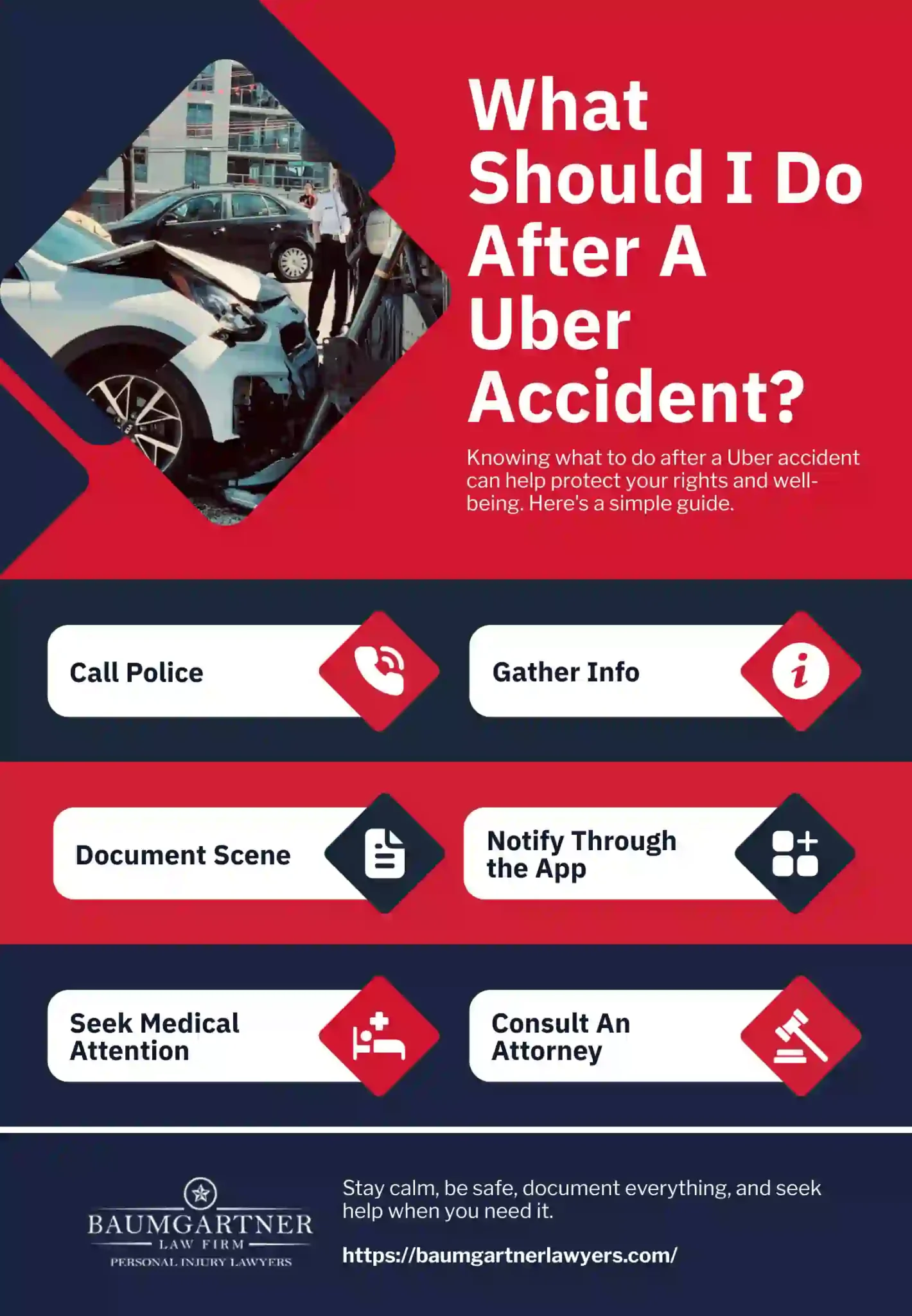
After an Uber accident in Houston, take these steps if you can do so safely:
- Call 911 and get medical help for anyone who is hurt.
- Report the crash in the Uber app through the Safety Toolkit or Help section.
- Screenshot the trip receipt, driver name, driver photo, vehicle information, route, and pickup/drop-off details.
- Photograph the vehicles, crash scene, traffic signals, road conditions, and visible injuries.
- Get names, phone numbers, and insurance information from all drivers involved.
- Get witness names and phone numbers.
- Seek medical care as soon as possible, even if you think the injury is minor.
- Do not give a recorded statement to any insurer until you understand your rights.
- Speak with a rideshare accident lawyer if you were injured, fault is disputed, or an insurer contacts you quickly.
Two steps are Uber-specific: report the crash in the app and save the app evidence. Those records may help prove the ride was active and which insurance coverage applies.
How Long Do You Have to File an Uber Accident Lawsuit in Texas?
In most Texas Uber accident cases, you have two years from the date of the crash to file a personal injury lawsuit. That deadline comes from Texas Civil Practice and Remedies Code Section 16.003. If you miss it, the court can dismiss the case even if your injuries are serious.
Do not wait until the deadline is close. Uber accident claims depend on app data, dashcam footage, camera video, driver records, medical proof, and witness statements. Some of that evidence can disappear in days or weeks.
Claims involving children, government vehicles, or unusual facts may have different rules. The safe move is to get advice early.
Do I Need a Lawyer After an Uber Accident?
You should consider hiring a lawyer after an Uber accident if you were injured, fault is disputed, more than one driver was involved, or any insurer is pressuring you to settle. Rideshare claims involve overlapping policies and app-based evidence that most people cannot get on their own.
You may not need a lawyer for a minor property damage claim with no injury. But if you needed medical care, missed work, or received calls from several insurers, legal help can protect you from mistakes and help identify all available coverage.
A free consultation can help you understand whether the case is something you can handle yourself or whether you need help.
Does Uber Pay for Accidents Caused by Its Drivers?
Yes — Uber’s insurance pays for accidents caused by its drivers. But it pays only when the driver was logged into the app, and only up to the limits of the phase that applied. Uber itself rarely pays directly, because it treats drivers as contractors, not employees.
This distinction confuses most people. You generally don’t sue Uber the company. Instead, you claim against the insurance Uber must carry under Texas Insurance Code Chapter 1954. If the driver was offline, Uber’s coverage wouldn’t apply. You’re left with the driver’s personal policy. Rare exceptions exist, like claims tied to careless driver screening. But the insurance route is how nearly every case gets paid.
What Happens if My Uber Driver Gets in an Accident While I’m a Passenger?
If your Uber driver gets in an accident while you are a passenger, Uber’s $1 million policy may apply because the ride was active. As a passenger, you usually are not at fault. The main questions are which driver caused the crash, what insurance applies, and how serious your injuries are.
You may have more than one claim. If the Uber driver caused the crash, the claim may involve Uber’s insurance. If another driver caused the wreck, that driver’s insurance may apply. If that driver has little or no insurance, UM/UIM coverage may become important.
After the crash, report it in the Uber app, get medical care, save your trip details, and speak with a lawyer before giving recorded statements.
Frequently Asked Questions About Houston Uber Accident Claims
If you were injured in an Uber accident in Houston, you likely have questions about who pays, what insurance applies, how long you have to act, and what your case may be worth. Here are answers to some of the questions we hear most often from passengers, drivers, pedestrians, and families after rideshare crashes.
How long do I have to file a lawsuit after an Uber accident in Texas?
In most cases, Texas gives injured people two years to file a personal injury lawsuit after an Uber accident.
It is important not to wait until the deadline is close. Uber accident claims often involve app-based records, trip details, witness statements, and insurance questions that should be investigated early. Acting quickly can make it easier to preserve evidence and protect your claim.
How much does it cost to hire a Houston Uber accident lawyer?
Most Houston Uber accident lawyers handle these cases on a contingency fee basis, which means there is no upfront attorney’s fee.
Instead of paying out of pocket at the start of the case, the lawyer is paid only if there is a recovery through settlement or verdict. This allows injured people to get legal help without paying fees in advance.
How does Uber's insurance coverage work in Texas?
Uber's insurance policies in Texas operates in three distinct phases. When the driver is offline (app is off), only the driver's personal auto insurance applies. When the driver is online and waiting for a ride request, Uber provides contingent liability coverage of up to $50,000 per person and $100,000 per accident, plus $25,000 in property damage. When the driver has accepted a ride or has a passenger in the vehicle, Uber provides $1 million in liability coverage. However, navigating these policies can be extremely complex, and insurance companies often dispute which policy applies or try to minimize payouts. That's why having an experienced Houston Uber accident lawyer is critical to ensuring you receive fair compensation from the appropriate insurance carrier.
Can I sue Uber after an accident in Houston?
Usually, an Uber accident claim is made against the at-fault driver and the available insurance policies, not Uber directly.
That is because Uber drivers are generally treated as independent contractors rather than employees. Even so, Uber’s insurance coverage may still play a major role in the case if the driver was logged into the app, had accepted a ride, or was carrying a passenger when the crash occurred.
Whether Uber itself can be sued depends on the specific facts, but most injury claims focus first on liability, app status, and insurance coverage.
Does Uber usually settle accident cases out of court?
Many Uber accident cases settle out of court, but whether a case settles depends on liability, injuries, insurance coverage, and the strength of the evidence.
Some claims resolve through settlement negotiations, while others require a lawsuit or trial preparation before serious offers are made. The most important issue is not simply whether the case settles, but whether the settlement fully reflects the injured person’s losses.
How much is my Houston Uber accident case worth?
The value of a Houston Uber accident case depends on your injuries, medical expenses, lost income, pain and suffering, and the insurance coverage available.
There is no fixed average settlement for an Uber accident because every case is different. A claim involving minor injuries and short-term treatment will usually be worth less than a case involving surgery, permanent injury, disability, or long-term medical care. Fault also matters. If liability is disputed or more than one driver was involved, that can affect the value of the claim.
In many Uber accident cases, the most important factors are the seriousness of the injuries, the total medical treatment, whether future care is needed, whether the victim missed work, and which insurance policies apply.
Can an Uber passenger recover compensation after a crash?
Yes. An injured Uber passenger can usually seek compensation after a crash.
In many cases, the passenger may have a claim against the Uber driver, another at-fault driver, or more than one insurance policy. Because passengers usually are not the ones who caused the collision, the main legal questions are who was at fault, what insurance applies, and how serious the injuries are.
An injured passenger may be able to recover compensation for medical bills, lost wages, pain and suffering, impairment, and other accident-related losses.
testimonials
Here’s What Our Personal Injury Clients Say
“DEDICATED TO HELPING HIS CLIENTS AND GOING THE EXTRA MILE TO GET THINGS DONE”
He is an attorney that is dedicated to helping his clients and going the extra mile to get things done. I would not hesitate to use him again and he is the only attorney that our family will use in the future. I honestly could not ever imagine such a great experience coming out of such an awful accident.
R. Alcorn
“I WOULD 100% RECOMMEND THE BAUMGARTNER LAW FIRM”
I would 100% recommend the Baumgartner Law Firm to any friends and family who not only wanted to the best outcome but wanted a lawyer who listened and upheld the integrity of Law and client to attorney relationship.
S. Arnold
“BEST ATTORNEY IN THE WORLD!!!!!”
Best Attorney in the World!!!!! I did not have a very high opinion of attorneys until I met Greg Baumgartner. He is the most decent and honest attorney I have ever dealt with.
K. Kaiyune

Talk to a Houston Uber Accident Lawyer Today
If you were hurt in a Houston Uber accident, do not let the insurance companies decide the value of your claim before the evidence is protected. These cases can involve disputed fault, several insurance policies, and app-based records that should be preserved early.
Baumgartner Law Firm offers free consultations. You work directly with Greg Baumgartner, and there is no attorney’s fee unless we recover money for you.
Call (281) 587-1111 or schedule a free consultation today.
Don’t let Uber’s corporate legal team dictate the value of your injury. Trust a Houston-based firm with a Houston personal injury lawyer who is Preeminent AV Rated and has a track record of multi-million dollar results.
6711 Cypress Creek Pkwy, Houston, TX 77069
Phone: (281) 587-1111
SCHEDULE YOUR FREE CONSULTATION NOW!
"*" indicates required fields
We will answer you within 24 hours via email, or you can call us directly for immediate help.