
Houston Truck Accident Lawyer
40+ Years Handling Serious 18-Wheeler and Commercial Truck Cases


A Houston truck accident lawyer investigates the trucking company, not just the driver: the driver’s qualification file, the truck’s electronic logs and black-box data, and every insurance policy that applies. I send preservation demands within days, because carriers can lawfully overwrite that data. Call before the truck is repaired or you give any recorded statement.
An 18-wheeler crash can change a family in seconds. The trucking company may have investigators and insurance representatives working before the road is cleared. You need someone protecting your side just as quickly.
I am Greg Baumgartner. For more than 40 years, I have represented people and families after serious truck and commercial vehicle crashes. My firm moves fast to preserve evidence, identify every responsible party, and build a case for full compensation. We have never lost a trucking case.
Call (281) 587-1111 or request a free, confidential case review. You pay no attorney fee unless we recover money for you.
40+ Years Personal injury experience | Undefeated In trucking cases | Millions Recovered in truck and commercial vehicle cases | No Fee Unless we recover money |
Legally reviewed by Greg Baumgartner, Texas attorney licensed since 1984 | Updated October 25, 2026






Proven Results in Truck and Commercial Vehicle Cases
A strong truck case requires more than a large demand. It requires proof that can withstand the trucking company’s defenses. These results show our experience handling serious injuries, disputed fault, multiple defendants, and wrongful death claims.
$5 MillionCommercial Vehicle Spinal Injury The defendants denied responsibility. After extensive litigation, the case was resolved for $5 million. | $3.75 MillionCommercial Vehicle Head Injury Our client was rear-ended at high speed on a Houston highway. Multiple defendants were involved, and the case resolved during trial. |
$3.55 Million18-Wheeler Wrongful Death A tractor-trailer backed across a roadway while making a delivery. The defense blamed the victim. We filed suit and secured a $3.55 million recovery before trial. | $3 MillionSemi-Truck Crash With Back Surgery A series of highway collisions created several claims. Our client required back surgery, and we obtained the largest recovery among the claims arising from the crash. |
See more truck and commercial vehicle case results. Past results do not guarantee a similar outcome. Every case depends on its facts, evidence, law, insurance, and damages.
For a FREE Consultation Contact Us Today
"*" indicates required fields


Meet Greg Baumgartner: Truck Accident Experience Since 1985
I began handling truck accident cases in 1985 and have handled more than 100 cases involving commercial vehicle accidents. That experience has taught me to look closely at the records behind a driver’s version of what happened.
In one case, a truck driver had falsified his logbooks. I subpoenaed his cellphone records and compared them with his logs. Cross-checking those records proved he had been driving beyond his permitted hours. The violation became clear when we compared independent evidence with the driver’s paperwork.
Truck drivers and trucking companies are subject to special safety rules that can help establish negligence. Knowing which rules apply—and how to find evidence of a violation—is key to handling these cases. My focus is on finding the evidence that explains what went wrong and how it contributed to the crash.
I personally handle the investigation, case strategy, driver and company depositions, expert selection, settlement negotiations, and trial preparation. Baumgartner Law Firm accepts a limited number of serious cases so I can stay closely involved and clients can speak directly with me.
I hold a Juris Doctor and a Master of Laws degree and graduated from the Trial Lawyers College. You can learn more about my background and approach to representing clients.
Why Truck Accident Cases Are Different
A truck crash is not simply a larger Houston car accident claim. Commercial carriers operate under safety rules that do not apply to most drivers. The most important evidence may be controlled by the trucking company, its insurer, a maintenance vendor, a cargo company, or another business involved in the trip.
A serious case may involve several insurance policies and several responsible parties. The defense may also have investigators, experts, and lawyers working from day one. That is why early action matters.
- Electronic records may show speed, braking, engine activity, driver hours, GPS history, and communications before the crash.
- Company files may reveal unsafe hiring practices, inadequate training, falsified logs, pressure to meet delivery schedules, or recurring safety problems.
- Maintenance and inspection records may show defects in the brakes, tires, steering, lighting, or trailer.
- Cargo records may help explain a rollover, jackknife truck accident, shifting load, or loss of control.
- Severe injuries and wrongful death claims require careful proof of future medical needs, lost earning capacity, and the full human loss to the family.
What We Do Immediately After We Are Hired
In my experience, the first days after a serious truck crash can shape the entire case. We first focus on evidence that may disappear, be overwritten, or remain under the motor carrier’s control.
- Send preservation notices to the trucking company, insurer, vehicle owner, and other parties who may control evidence.
- Identify the motor carrier, driver, tractor and trailer owners, cargo interests, maintenance companies, and available insurance coverage.
- Inspect the vehicles and crash scene when the facts require it.
- Seek truck black box and event data recorder evidence and electronic logging device, GPS, telematics, dashcam, and onboard camera information.
- Obtain driver qualification, dispatch, hours-of-service, fuel, toll, phone, maintenance, inspection, and cargo records.
- Interview witnesses and work with qualified reconstruction, trucking safety, medical, and economic experts when needed.
The goal is not to collect every possible record. It is to find the evidence tied to the cause of the crash and the harm it created. Learn more about our Houston truck accident investigation process.

Houston 18-Wheeler Accident Claims
Most of the serious truck cases I handle involve an 18-wheeler. A tractor-trailer can weigh 80,000 pounds, and the company that put it on the road is regulated in ways a private driver is not. That is what makes these claims different, and it is where the case is usually won or lost.
The driver qualification file
Federal rules require every motor carrier to keep a qualification file on each driver: the employment application, the driving record the carrier pulled before hiring, the road test, the medical examiner’s certificate, and the annual review of violations. The file shows what the company knew about its driver and when. In a Houston 18-wheeler accident case it is the first record I demand, along with the hours-of-service logs and electronic logging device data. Our pages on federal trucking regulations and negligent hiring explain what each record proves.
Insurance that is nothing like a car policy
An interstate carrier hauling general freight must carry at least $750,000 in liability coverage. Hauling hazardous materials, the minimum rises to $1 million or $5 million depending on the cargo. Most carriers of any size also hold excess or umbrella coverage above that. The adjuster’s first offer is never the limit, and the policy limit is rarely the full value of a serious case. See how a truck accident settlement is valued.
More than one defendant
An 18-wheeler crash usually has more than one responsible party: the driver, the motor carrier, the owner of the tractor or trailer, the broker that arranged the load, the shipper that loaded it, and the shop that maintained the truck. Each has its own insurance and its own records. Identifying all of them early is how we find the full coverage and the full story. The next section explains who may be responsible and why; negligent maintenance covers the repair and inspection side.
Who May Be Responsible for a Houston Truck Crash?
The evidence determines who should be held responsible. Not every case involves the same defendants, and filing against the wrong parties can waste time and weaken the focus of the claim.
Truck driver: A driver may be responsible for speeding, distraction, fatigue, impairment from alcohol or drugs, unsafe turns, following too closely, or other careless driving.
Motor carrier or employer: A company may be responsible for a driver acting within the scope of the job. It may also be directly responsible for unsafe hiring, training, supervision, scheduling, or safety practices.
Maintenance or repair company: A contractor may share responsibility when poor inspection or repair work contributes to brake, tire, steering, or other equipment failure.
Shipper, loader, or cargo company: Improper loading, securement, or weight distribution may contribute to a rollover, jackknife, cargo spill, or loss of control.
Vehicle or parts manufacturer: A defective truck, trailer, tire, brake component, coupling system, or safety device may create a product liability claim.
Other motorists or businesses: A passenger vehicle driver, construction company, property owner, or another business may share fault depending on how the crash occurred.
Our investigation may include a close review of negligent hiring and retention by a trucking company and the records that show whether the driver was qualified and properly supervised.
Contact the Undefeated 18-Wheeler Accident Attorney in Houston with Decades of Expertise and a Proven Track Record.
Houston Truck Accident Facts and Local Evidence
 Houston is a major freight center. Commercial trucks move through I-10, I-45, I-69/US 59, US 290, Loop 610, Beltway 8, and the Ship Channel area every day. A serious crash in this region can involve evidence held by public agencies, toll-road systems, nearby businesses, industrial facilities, warehouses, and private fleets.
Corridors where we see the most serious truck crashes
Houston is a port city and a freight hub, and the trucks follow the same routes every day. The crashes I see most come from I-10 East between downtown and the Ship Channel, where container traffic from the Port of Houston merges with commuters; I-45 North through Spring, The Woodlands and Conroe; I-69/US-59 through Humble, Kingwood and Atascocita; and the loops that tie them together, Beltway 8, I-610 and the Grand Parkway. US-290 through Cypress and I-10 West toward Katy add construction and gravel-haul traffic to that list. Where the crash happened tells us which cameras, which weigh stations, and which police agency hold the evidence.
Where the case is filed
A crash in Houston is usually filed in the Harris County district courts. Crashes in The Woodlands or Conroe go to Montgomery County; Sugar Land and Katy cases may go to Fort Bend County. When the trucking company is based out of state, it will often move the case to federal court in the Southern District of Texas, Houston Division. We prepare every case for either courtroom from day one.
According to the Texas Department of Transportation’s 2024 county report, Harris County had 6,313 crashes involving commercial motor vehicles. Those crashes included 41 fatalities and 112 suspected serious injuries.
Local evidence may include a police or DPS crash report, 911 recordings, body-camera footage, toll records, traffic or business video, witness information, and scene measurements. A police report is useful, but it is often only the starting point. TxDOT explains how Texas collects and maintains crash reports and records.
Why Local Investigation Matters
Video can be overwritten, vehicles can be repaired, and electronic data can be lost. A lawyer familiar with Houston’s road system and commercial traffic can identify likely evidence sources and act before they disappear.
Common Causes of 18-Wheeler Accidents
Truck crashes often have more than one cause. A truck driver error may be connected to company pressure, poor training, unsafe equipment, or a failure to enforce basic safety rules. Our guide to the common causes of truck accidents in Houston explains how these failures can overlap.
• Driver fatigue and hours-of-service violations that reduce alertness and reaction time
• Distracted driving, including phone use, dispatch messages, and in-cab devices
• Speeding, following too closely, and driving too fast for traffic or weather
• Wide-turn truck accidents, unsafe lane changes, and failure to account for trailer off-tracking
• Blind-spot truck collisions involving cars, motorcycles, bicycles, or pedestrians
• Jackknife truck accidents caused by braking, speed, road conditions, equipment, or cargo issues
• Negligent truck maintenance involving brakes, tires, steering, lights, or trailer components
• Unsafe hiring and poor driver training, lack of supervision, or pressure to meet an unrealistic schedule
• Improper loading, overweight cargo, shifting loads, or failed cargo securement
• Alcohol, drugs, medical problems, or other conditions that make the driver unsafe
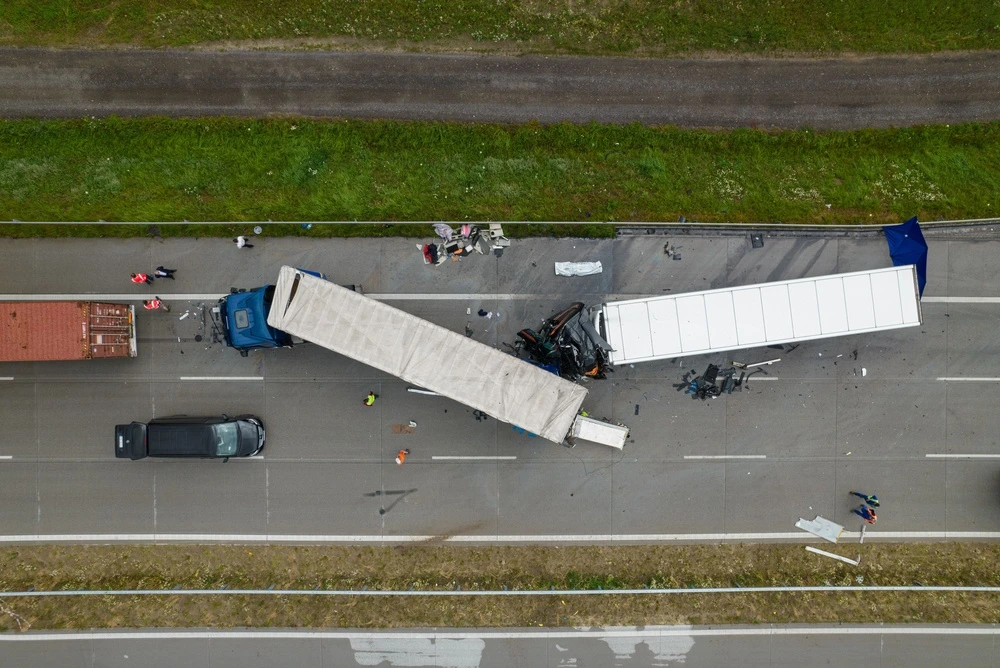
Federal rules limit driving and on-duty time and require rest periods. The FMCSA hours-of-service rules are intended to reduce fatigue. Logs, ELD records, dispatch data, toll receipts, fuel records, and phone data may show whether a driver exceeded legal limits or recorded false rest periods.
Motor carriers must also systematically inspect, repair, and maintain vehicles under their control. The FMCSA inspection and maintenance requirements can become important when brakes, tires, steering, lights, or other equipment contributed to the crash.
Texas law also affects how some commercial vehicle cases are presented. Under Chapter 72 of the Texas Civil Practice and Remedies Code, the investigation should connect a safety failure to the cause of the crash. A poor company record alone is not a substitute for proof that the failure contributed to the collision.
Compensation Available After a Truck Accident
The value of a case depends on the injuries, available insurance, strength of the liability evidence, future medical needs, loss of income, and how the crash has changed the person’s life. There is no honest “average” that can value every case.
Past and future medical expenses
Lost wages and reduced earning capacity
Physical pain and mental anguish
Physical impairment and disfigurement
Property damage and other accident-related expenses
Loss of consortium or household services when supported by the facts
Wrongful death and survival damages when a family member is killed
Read more about how truck accident settlement value is evaluated. When a crash causes a death, our Houston wrongful death lawyer page explains the claims that may be available to the family and the estate.
In rare cases, punitive damages in a Texas truck accident case may be available when clear and convincing evidence proves fraud, malice, or gross negligence.

Serious Injuries We See in Truck Cases
A Houston truck accident lawyer investigates the trucking company, not just the driver: the driver’s qualification file, the truck’s electronic logs and black-box data, and every applicable insurance policy. I send preservation demands within days, because carriers can lawfully overwrite that data. Call before the truck is repaired or you give any recorded statement.
An 18-wheeler crash can cause life-changing harm. Our firm handles truck cases involving traumatic brain injuries, spinal cord and back injuries, fractures, internal injuries, burns, amputations, permanent impairment, and fatal injuries.
Families can learn more about claims involving a traumatic brain injury or a spinal cord injury. In severe injury cases, we work with treating doctors and qualified experts to explain future care, lost earning capacity, life-care needs, and the long-term effect on the family.
Types of Truck Accident Cases We Handle
We handle all kinds of commercial vehicle crashes in the Houston area: 18-wheeler and tractor-trailer collisions, including jackknife, underride, blind-spot, and wide-turn crashes; delivery vehicles from Amazon, FedEx, and UPS; and tow trucks, garbage trucks, dump trucks, and other work vehicles.
Many of these cases involve a death. When they do, we handle the wrongful death claim alongside the injury claims so the family deals with one lawyer, not two.
What to Do After a Houston Truck Accident
Your health comes first. The following steps can also protect important evidence and reduce avoidable disputes with the insurance company.
- Call 911 and report the crash. Ask for emergency medical help when needed.
- Get medical care promptly, even if some symptoms appear later.
- Take photos and video of the vehicles, road, debris, skid marks, traffic controls, and visible injuries if you can do so safely.
- Get witness names and contact information. Do not assume the police report will include every witness.
- Do not give a recorded statement to the trucking company’s insurer or sign broad medical releases before getting legal advice.
- Keep medical bills, wage records, receipts, photographs, and all communications about the crash.
- Speak with an experienced truck accident lawyer before the vehicles are repaired or key electronic records are lost.
For a more detailed checklist, review what to do after a truck accident in Houston.
Texas Deadlines and Fault Rules
Two-year filing deadline: Most Texas personal injury and wrongful death lawsuits must be filed within two years, although exceptions may change the deadline. See Texas Civil Practice and Remedies Code Section 16.003. Waiting can also make evidence harder to find, even when the legal deadline has not expired.
Texas 51% fault rule: An injured person generally cannot recover damages if found more than 50% responsible. A recovery can be reduced by the person’s percentage of fault when it is 50% or less. See Texas Civil Practice and Remedies Code Section 33.001.
Houston Truck Accident FAQs
What should I do after a serious truck accident in Houston?
Get medical care first, then preserve what you can: photos of the truck, trailer, company markings and USDOT number, witness names, and every bill and record. Do not give the trucking company’s insurer a recorded statement before you have spoken with a lawyer, because electronic data can be overwritten and the truck can be repaired within days. The full checklist is in What to Do After a Houston Truck Accident above.
Who can be held liable for an 18-wheeler accident?
Liability may extend beyond the truck driver. Depending on the facts, the trucking company, tractor or trailer owner, maintenance contractor, cargo company, broker, shipper, manufacturer, or another driver may share responsibility. The key is to follow the evidence rather than assume the person behind the wheel is the only responsible party. We look at who hired and supervised the driver, who controlled the trip, who maintained the equipment, how the load was handled, and whether company practices contributed to the crash.
What tactics do insurance adjusters use to underpay and deny truck accident claims?
Insurance companies employ tactics such as delays and denials to manage truck accident injury claims. They may request excessive paperwork or conduct lengthy investigations, making the process frustrating for victims. This can lead victims to accept lower settlements or abandon their claims.
Trucking companies may try to blame you or others for the accident. They might say you share some responsibility, which could reduce the amount of compensation you receive.
Insurance companies offer low amounts to settle claims quickly. They hope that people who need money will accept less than what their damages are worth.
Defense lawyers or insurance investigators might monitor you to find evidence that could harm your case. They use this information to challenge your honesty. The truck accident attorneys at Baumgartner Law Firm in Houston can help protect your rights against these unfair tactics.
What evidence is important in a Houston truck accident case?
Important evidence may include electronic control module data, electronic logging records, GPS and telematics data, dash-camera video, driver qualification files, dispatch records, maintenance and inspection records, cargo documents, phone records, witness statements, and crash-scene evidence. Not every case requires every record. My focus is on finding the evidence that explains why the crash happened and who is responsible. That is why a prompt truck accident investigation can matter in a serious case.
What is a truck’s “black box,” and can it help prove what happened?
A commercial truck may contain electronic systems that record useful information about the vehicle and the trip, although the available data depends on the truck and its equipment. Potential evidence can include speed, braking, engine activity, fault codes, GPS data, hours-of-service data, and other telematics data. These systems are not identical, and they do not preserve every fact about a crash. The important point is to identify what data exists and seek to preserve it before it is lost or overwritten.
How long do I have to file a truck accident lawsuit in Texas?
Texas law generally gives an injured person two years to file a personal injury lawsuit, but exceptions can shorten or change the deadline. Texas Civil Practice and Remedies Code Section 16.003 sets the general two-year limitations period for personal injury and wrongful death claims. Claims involving a government entity or other special circumstances may have additional notice requirements or different rules. Waiting is also risky because evidence can disappear long before the limitations period expires. Learn more about filing a truck accident lawsuit in Houston.
Can I recover compensation if I was partly at fault for the truck crash?
Possibly. Under Texas proportionate-responsibility law, a claimant generally may recover damages if the claimant is 50% or less responsible, but the recovery is reduced by the claimant’s percentage of responsibility. Texas Civil Practice and Remedies Code Section 33.001 bars recovery when the claimant’s percentage of responsibility is greater than 50%. Fault disputes are often evidence-driven, so I would not assume an insurer’s initial percentage is correct without examining the crash evidence.
How much is a Houston truck accident case worth?
There is no honest average value for a truck accident case. Case value depends on the severity and permanence of the injuries, medical expenses, lost income, future care, pain and impairment, fault, available insurance, and the strength of the evidence. A severe spinal injury or wrongful death case is evaluated very differently from a short-term soft-tissue claim. I prefer to understand the medical picture and liability evidence before putting a value on a serious case. Our truck accident settlement guide explains the factors that usually drive value.
How much does it cost to hire Baumgartner Law Firm for a truck accident case?
There is no upfront attorney fee to hire Baumgartner Law Firm for a truck accident case. We handle these cases on a contingency fee basis, which means the attorney fee is paid from the recovery if we obtain compensation for you. We explain the fee agreement before you hire us so you know how the arrangement works. You can also review our page explaining the cost of hiring a Houston truck accident lawyer.
Truck accident cases we handle in Houston
Amazon and delivery van accidentsClaims against Amazon, DSPs, and contract drivers after a van crash
FedEx truck accidentsFedEx Ground contractors, Express drivers, and who is liable
UPS truck accidentsPackage car and tractor-trailer crashes involving UPS
Jackknife accidentsWhy trailers swing out, and the braking and speed evidence that proves fault
Underride accidentsCars that slide beneath a trailer; guards, lighting, and fatal-crash claims
Blind spot crashesNo-zone collisions and the mirror, camera, and sensor evidence
Wide-turn accidentsRight-turn squeeze crashes at Houston intersections
Tow truck accidentsWreckers, flatbeds, and roadside recovery crashes
Garbage truck accidentsCity and private hauler crashes, including stop-and-go collisions
We also handle sideswipe truck accidents, rear-end and stalled-vehicle crashes — see all truck accident case types →
Guides for your truck accident claim
- What to do after a truck accident in Houston
- Failure to keep a proper lookout
- FMCSA violations in truck accident cases
- Why truck crash settlements are larger than car crash settlements
- How long an 18-wheeler case takes to settle
- Texas truck accident statistics
Communities we serve
Greg Baumgartner represents truck accident victims across the Houston area, including Cypress, Spring, The Woodlands, Conroe, Tomball, Katy, Humble, Kingwood, Atascocita, Pearland, and Sugar Land. Home and hospital consultations are available by appointment.
Related reading
Types of commercial driver’s licenses in Texas
Interstate vs. intrastate trucking
The deadliest highways in Texas
Commercial vehicle accidents
Bus accidents
DoorDash and delivery driver accidents
Highway accidents
Wrongful death after a truck crash
Punitive damages for gross negligence
Truck driver logbooks in truck accident lawsuits
6 mistakes to avoid when filing a truck accident claim
The most common injuries in truck accidents
Key factors in Houston truck accident lawsuits
Handling an 18-wheeler case without an attorney
Here’s What Our Clients are Saying
“DEDICATED TO HELPING HIS CLIENTS AND GOING THE EXTRA MILE TO GET THINGS DONE”
He is an attorney that is dedicated to helping his clients and going the extra mile to get things done. I would not hesitate to use him again and he is the only attorney that our family will use in the future. I honestly could not ever imagine such a great experience coming out of such an awful accident.
R. Alcorn
“I WOULD 100% RECOMMEND THE BAUMGARTNER LAW FIRM”
I would 100% recommend the Baumgartner Law Firm to any friends and family who not only wanted to the best outcome but wanted a lawyer who listened and upheld the integrity of Law and client to attorney relationship.
S. Arnold
“BEST ATTORNEY IN THE WORLD!!!!!”
Best Attorney in the World!!!!! I did not have a very high opinion of attorneys until I met Greg Baumgartner. He is the most decent and honest attorney I have ever dealt with.
K. Kaiyune

FREE CONSULTATION
Talk Directly With Houston Truck Accident Lawyer Greg Baumgartner
Call (281) 587-1111 or contact Baumgartner Law Firm online for a free, confidential consultation. Our Houston office is at 6711 Cypress Creek Parkway, Houston, Texas 77069. There is no attorney fee unless we recover money for you.
Baumgartner Law Firm
6711 Cypress Creek Pkwy
Houston, Texas 77069
(281) 587-1111
Request a Free Consultation
"*" indicates required fields
We will answer you within 24 hours via email, or you can call us directly. We are always ready to help. If immediate assistance is needed, call us at (281) 587-1111. We are available 24 – 7.