
Houston Negligent Hiring Truck Accident Lawyer
When a trucking company puts an unsafe driver behind the wheel, the crash may not be just a driver mistake. It may be the result of poor hiring, weak training, ignored warning signs, or a company decision to keep a dangerous driver on the road. If you or someone you love was hurt in a serious truck crash, a Houston truck accident lawyer at Baumgartner Law Firm can investigate whether the motor carrier, driver, broker, maintenance company, or another party may be responsible.
Negligent hiring and negligent retention claims often depend on records that the injured person cannot get alone. Driver qualification files, prior employer checks, motor vehicle records, training documents, medical certification records, drug and alcohol records, and company safety policies may tell the real story. These documents can show whether the trucking company followed federal safety rules before the wreck happened.
Bottom line: A trucking company may be liable when it hires, trains, supervises, or keeps a driver it knew or should have known was unsafe. In many serious truck accident cases, the key question is not only what the driver did. It is what the company knew before the crash and what it failed to do about it.
What Is Negligent Hiring in a Truck Accident Case?
Negligent hiring means a company hired a driver when it knew, or should have known, that the driver was not safe or qualified for the job. In a truck accident case, that may involve a driver with prior crashes, serious traffic violations, a poor safety record, a suspended or restricted license, medical problems, drug or alcohol issues, or a lack of proper commercial driving experience.
Commercial trucks are not ordinary vehicles. A fully loaded tractor-trailer may weigh up to 80,000 pounds. That size makes safe hiring and training critical. A trucking company should not treat driver screening as paperwork. It is a safety step meant to protect everyone sharing the road.
In a Houston truck accident case, negligent hiring may become important when the crash was caused by an unqualified driver, an inexperienced driver, a medically unfit driver, or a driver who should never have been trusted with a commercial vehicle. A careful truck accident investigation can uncover whether the motor carrier skipped required checks or ignored clear signs of danger.
Negligent Hiring vs. Negligent Retention
Negligent hiring and negligent retention are related, but they are not the same.
Negligent hiring happens before the driver is put on the road. The issue is whether the trucking company should have hired the driver in the first place. A company may be negligent if it failed to check the driver’s license history, prior employers, crash history, training background, medical qualification, or drug and alcohol status before giving the driver a truck.
Negligent retention happens after the driver is hired. The issue is whether the company kept using the driver after learning about safety problems. Warning signs may include repeated speeding tickets, logbook violations, preventable crashes, failed inspections, complaints, drug or alcohol concerns, medical qualification issues, or unsafe driving behavior reported by others.
Both theories matter because a trucking company may try to blame only the driver. But if company records show that management ignored risks, the case may involve a broader company safety failure.
When a Trucking Company Should Not Have Hired a Driver
A trucking company should take reasonable steps before allowing a driver to operate a tractor-trailer, delivery truck, dump truck, tanker, garbage truck, or other commercial vehicle. The company should look beyond whether the driver has a commercial driver’s license. A CDL alone does not mean the driver is safe for every job, route, vehicle, or cargo load.
A company may have a negligent hiring problem when it hires a driver who:
- Had prior serious crashes or a pattern of unsafe driving.
- Had repeated moving violations, speeding tickets, or reckless driving history.
- Did not have the right CDL class or endorsement for the job.
- Had a medical condition that affected safe driving.
- Had unresolved drug or alcohol testing problems.
- Had been fired or disciplined by another motor carrier for safety reasons.
- Was not properly trained for the truck, cargo, route, or job duties.
- Could not safely pass a road test or equivalent screening.
- Had gaps, conflicts, or red flags in prior employment records.
- Was placed on the road before the required paperwork was complete.
The details matter. Some violations may not, by themselves, prove negligent hiring. But a pattern of ignored risks can show that the company cared more about filling a seat than protecting the public.
Federal Rules for Hiring and Qualifying Truck Drivers
Trucking companies must follow federal safety rules that apply to many commercial motor carriers and drivers. These rules are not just technical requirements. They are designed to keep unsafe drivers and unsafe trucks off the road. Violations of those rules can become powerful evidence in a serious injury or wrongful death case.
The Federal Motor Carrier Safety Administration explains that motor carriers must maintain FMCSA driver qualification files for employed drivers. Federal regulation 49 CFR § 391.51 also requires each motor carrier to maintain a driver qualification file for each driver it employs.
Federal rules may also involve prior employer safety history, motor vehicle records, road testing, medical certification, and drug and alcohol testing. FMCSA’s entry-level driver training rules set baseline training requirements for certain drivers seeking a CDL, CDL upgrade, or certain endorsements. The FMCSA Drug and Alcohol Clearinghouse is another important safety tool because it gives employers and government agencies access to CDL driver drug and alcohol program violation information.
A trucking company that fails to follow these rules may create danger before the truck ever leaves the yard. For more background on how rule violations can affect a claim, see our guide to FMCSA violations in Houston truck accident cases.
What Is in a Driver Qualification File?
The driver qualification file is often one of the first records a lawyer wants in a negligent hiring case. It may show what the trucking company knew about the driver before the crash. It may also show whether the company followed the rules or rushed the driver onto the road without completing required safety checks.
Depending on the driver and the motor carrier, important qualification materials may include:
- The driver’s application for employment.
- Motor vehicle records from the driver’s licensing authority.
- Annual motor vehicle record reviews.
- Prior employer safety performance history.
- A road test certificate or accepted equivalent.
- CDL information and required endorsements.
- Medical examiner certification or CDLIS medical status information.
- Notes showing the medical examiner was properly listed when required.
- Drug and alcohol testing records or Clearinghouse-related information.
- Training records and safety instruction documents.
- Disciplinary history, warnings, or company safety notes.
Missing records can matter. Incomplete files, late documents, conflicting paperwork, or ignored red flags may help show that the company did not take safety seriously.

Evidence Used to Prove Negligent Hiring or Retention
Negligent hiring and retention claims are built with evidence. The police report usually does not tell the whole story. The most important proof is often in the hands of the trucking company, its insurer, its safety department, the driver, a broker, a maintenance vendor, or a third-party administrator.
Evidence that may help prove company negligence includes:
- The complete driver qualification file.
- The driver’s employment and personnel file.
- Prior crash and violation history.
- Prior employer communications and safety history checks.
- Driver training records, course materials, and instructor notes.
- Road test records or documents accepted in place of a road test.
- Medical qualification records.
- Drug and alcohol testing records.
- Electronic logging device data and hours-of-service records.
- Dispatch records, delivery schedules, and route pressure evidence.
- Safety meeting records and company policies.
- Internal emails, text messages, and safety communications.
- Post-crash internal investigation materials that are not privileged.
- Prior complaints about the driver.
- Corporate representative deposition testimony.
In some cases, filing suit is what gives the injured person access to this evidence. Formal discovery may reveal hiring files, training records, company policies, deposition testimony, and records that were not available during an insurance claim. Learn more about the litigation process on our page about filing a truck accident lawsuit in Houston.
Signs the Trucking Company May Be Responsible
A serious truck crash may involve company negligence when the facts show more than a one-time driving mistake. Warning signs include:
- The driver had a history of crashes, violations, or unsafe driving.
- The company could not produce a complete driver qualification file.
- The driver lacked proper training for the vehicle or load.
- The company ignored hours-of-service or ELD violations.
- Dispatch pressured the driver to keep moving despite fatigue.
- The company failed to check prior employers or licensing records.
- The driver had unresolved medical, drug, or alcohol concerns.
- The company kept the driver after repeated safety problems.
- Company records conflict with the driver’s version of events.
- The crash fits a pattern of preventable safety failures.
These issues may overlap with other causes of truck accidents in Houston, including fatigue, speeding, distraction, unsafe maintenance, overloaded cargo, and poor company supervision.
Why Company Negligence Can Strengthen a Truck Accident Case
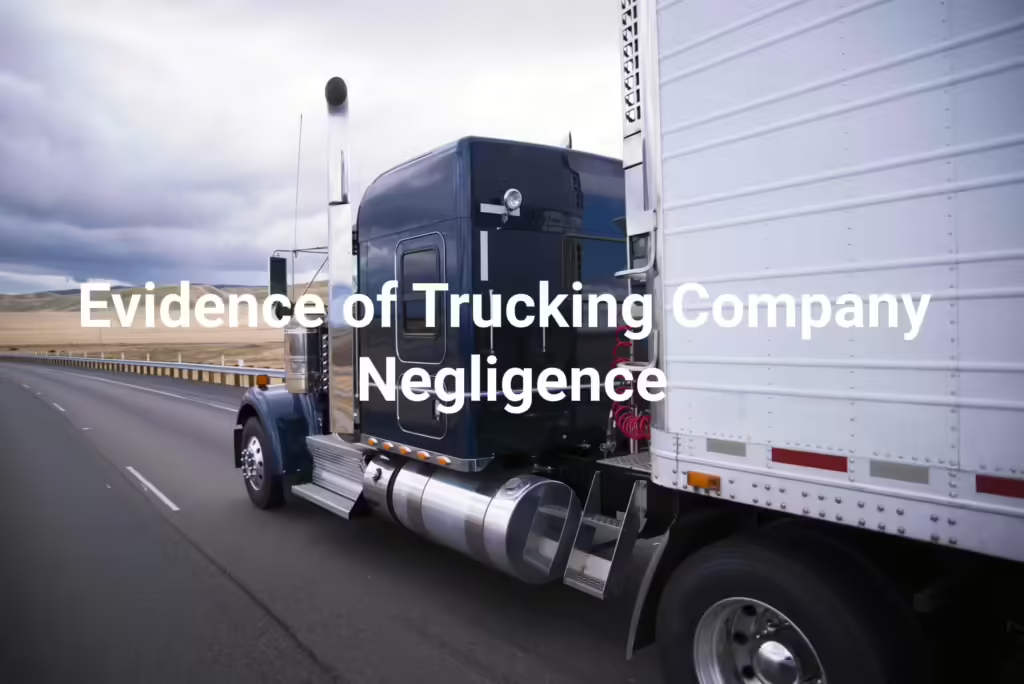
Negligent hiring or retention can change the direction of a truck accident case. Instead of focusing only on what happened in the final few seconds before impact, the case may show that the crash was the result of unsafe company decisions made days, weeks, or months earlier.
That can matter for several reasons. It may help prove liability. It may explain why the wreck was preventable. It may identify additional defendants or insurance coverage. In the right case, it may support a claim that the company consciously ignored known safety risks.
For example, a driver who causes a jackknife truck accident may have been poorly trained, pushed beyond safe hours, or kept on the road despite known problems. The crash scene tells only part of that story. Company records may tell the rest.
This is why early legal action is important. Trucking companies and insurers often move quickly after a major crash. Evidence can be lost, overwritten, repaired, or explained away. A preservation letter, early investigation, and targeted discovery can protect evidence before it disappears.
Call an UNDEFEATED TRUCK ACCIDENT LAWYER IN HOUSTON FOR HELP!
Our Experience With Negligent Hiring Truck Accident Cases
Baumgartner Law Firm has handled serious truck accident and commercial vehicle cases in Houston for decades. Our work often involves looking beyond the driver’s immediate mistake and asking harder questions about the company’s role.
In one case, a motor carrier hired an inexperienced driver and failed to make sure he could safely operate the tractor-trailer. The driver lost control, jackknifed across the highway, and caused a fatal crash. We investigated the company’s conduct and resolved the case for a multi-million dollar recovery at trial.
In another case, company records and driver evidence showed that a driver was cheating on logbooks and that the motor carrier should have known about the violations. After the safety failures were uncovered, the company paid our full multi-million-dollar demand.
We have also handled cases where driver training materials, deposition testimony, and company files showed that the driver lacked the training needed for the job. These cases show why experience matters. A strong truck accident case often depends on knowing what records to demand, what rules apply, and what questions to ask under oath.
For examples of prior recoveries, visit our case results page. Past results do not guarantee a similar outcome, because every case depends on its own facts.
Talk With a Houston Truck Accident Lawyer About Company Negligence
After a serious truck crash, it is normal to wonder whether the driver was the only person at fault. Often, the answer is no. A motor carrier may share responsibility if it hired an unsafe driver, skipped required checks, ignored warning signs, failed to train the driver, or kept the driver on the road despite known safety problems.
Baumgartner Law Firm helps injury victims and families investigate serious truck accident cases in Houston and across Texas. We know how to examine driver qualification files, company safety records, FMCSA issues, ELD data, dispatch documents, training records, and corporate conduct.
If you were seriously injured or lost a loved one in a commercial truck crash, contact us for a free consultation. We can review what happened, explain your options, and help determine whether negligent hiring or retention may be part of your case. If the crash caused a fatal injury, you may also want to review our page for families seeking help from a Houston wrongful death lawyer.
Contact Baumgartner Law Firm today or call (281) 587-1111 for a free consultation. There is no fee unless we win.
Why 18-Wheeler Lawsuit Experience Matters
After a truck accident, the extent of the damage is often not immediately apparent to the victims or their families. Attorneys without a working knowledge of the safety regulations and experience in uncovering wrongdoing are at a substantial disadvantage.
The evidence against the trucking company and its driver will significantly impact the outcome of a personal injury case.
FAQs About Negligent Hiring Truck Accident Claims
Can I sue a trucking company for negligent hiring in Texas?
Yes. If a trucking company hired an unsafe or unqualified driver and that failure contributed to your crash, the company may be liable for negligent hiring. The key issue is whether the company knew or should have known the driver was unsafe before putting that driver on the road.
What is negligent retention in a truck accident case?
Negligent retention means the trucking company kept a dangerous driver on the road after learning about safety problems. Those problems may include crashes, moving violations, hours-of-service violations, failed inspections, drug or alcohol concerns, medical issues, or repeated unsafe driving behavior.
What records show negligent hiring by a trucking company?
Important records may include the driver qualification file, employment application, prior employer checks, motor vehicle records, CDL records, medical certification, road test documents, training records, drug and alcohol records, and company disciplinary records.
Why is the driver qualification file important?
The driver qualification file can show whether the motor carrier properly checked the driver’s background, license status, medical qualification, driving history, and required paperwork. Missing or incomplete records may help show that the company did not follow basic safety rules.
How does a lawyer get trucking company hiring records?
A lawyer may send evidence preservation letters, request records from the company or insurer, subpoena third parties when appropriate, and use discovery after a lawsuit is filed. In serious cases, depositions of company safety personnel may also be necessary.
Does negligent hiring apply only to 18-wheelers?
No. Negligent hiring may apply to many commercial vehicle cases, including tractor-trailers, delivery trucks, dump trucks, tow trucks, garbage trucks, buses, vans, tankers, and other work vehicles when a company puts an unsafe driver on the road.
What if the truck driver had a valid CDL?
A valid CDL does not end the inquiry. The company may still be negligent if the driver lacked proper training, had a poor safety history, was medically unfit, had drug or alcohol concerns, or was assigned work beyond the driver’s experience or qualifications.
Why should I act quickly after a truck accident?
Important trucking evidence can disappear, be repaired, be overwritten, or become harder to obtain. Early investigation can help preserve ELD data, driver files, company records, dash camera footage, maintenance records, and other evidence needed to prove what really happened.
Baumgartner Law Firm
Call an Experienced Truck Accident Lawyer In Houston for Help
Contact the Houston truck accident law firm for help with a personal injury claim.
OR
Fill out an online consultation request for a FREE consultation.
Suspect Negligence in Hiring a Driver? Call for a FREE Consultation- (281) 587-1111
testimonials
Client Reviews
Mayra T
Houston Personal Injury Victim
Mr. Greg is a great personal injury lawyer. Looking for the best help? Call Baumgartner Law Firm!
Brian Wilson
Houston Personal Injury Victim
I highly recommend this law office. Greg Baumgartner is knowledgeable, dependable, honest and truly has the client’s best interests at heart.
Callie M
Houston Personal Injury Victim
Greg, a personal Injury Lawyer at Baumgartner Law Firm represented me in my personal injury case. I am very happy with the case result. Baumgartner is a GREAT law firm with GREAT people. They get RESULTS.
Cindy S
Houston Personal Injury Victim
My experience with Baumgartner law firm was excellent. They took the time to hear my concerns and kept me informed throughout the process. They fought for the best resolution for my case. Working with Greg and Lissa gave me peace of mind in a scary and stressful situation. I highly recommend their services.
Mr. Greg is a great personal injury lawyer. Looking for the best help? Call Baumgartner Law Firm!
Mayra T
Houston Personal Injury Victim
I highly recommend this law office. Greg Baumgartner is knowledgeable, dependable, honest, and truly has the client's best interests at heart.
Brian Wilson
Houston Personal Injury Victim
Greg, a personal Injury Lawyer at Baumgartner Law Firm represented me in my personal injury case. I am very happy with the case result. Baumgartner is a GREAT law firm with GREAT people. They get RESULTS.
Callie M
Houston Personal Injury Victim
My experience with Baumgartner law firm was excellent. They took the time to hear my concerns and kept me informed throughout the process. They fought for the best resolution for my case. Working with Greg and Lissa gave me peace of mind in a scary and stressful situation. I highly recommend their services.
Cindy S
Houston Personal Injury Victim
NEED HELP? HAVE QUESTIONS?