
Houston Motorcycle Accident Lawyer
40+ years representing seriously injured accident victims in Houston and across Texas


Written and legally reviewed by Greg Baumgartner | Founder and lead trial lawyer | 40+ years of personal injury experience | Updated September 2026
Quick answer: If another driver caused your motorcycle crash in Houston, you may be able to recover compensation for medical bills, lost income, pain, disability, disfigurement, and other losses. I am Greg Baumgartner. I have represented seriously injured Texans since 1985, and I personally handle the major decisions in the cases my firm accepts. The consultation is free, and there is no attorney fee unless we recover compensation for you.
A serious motorcycle crash is not a routine fender-bender. A rider has little protection from the force of impact. In a few seconds, you can go from riding home to facing surgery, months away from work, and an insurance company asking questions before you know how badly you are hurt.
One thing I have learned after more than four decades of handling injury cases is that the first version of a motorcycle crash is not always the right one. A driver may say, “I never saw the motorcycle.” An adjuster may assume the rider was speeding. A police report may not include video, may reflect sight-line issues, or may omit evidence that was not available at the scene. My job is to test those assumptions against the physical and electronic evidence.
If you were seriously injured in a Houston motorcycle accident, call Baumgartner Law Firm at (281) 587-1111 or request a free case review online. We keep a selective caseload so I can stay involved in the important decisions on each case.
Houston Motorcycle Accident Claims: Quick Answers
Deadline | Texas generally gives an injured person two years to file a personal injury lawsuit, but exceptions and special notice rules can shorten or change the deadline. |
Partial fault | A rider can generally recover if they are 50% or less at fault. The recovery is reduced by the rider’s percentage of responsibility. |
Helmet use | Not wearing a helmet does not automatically decide who caused the crash. It may become relevant to certain injury-damage arguments. |
Attorney fee | Accepted motorcycle injury cases are handled on a contingency fee. There is no attorney fee unless the firm recovers compensation. |
Evidence | Video, vehicle damage, the motorcycle and riding gear, witnesses, lane position, sight distance, electronic data, and medical proof can all matter. |


Why Choose Baumgartner Law Firm After a Houston Motorcycle Accident?
A motorcycle injury case needs more than a demand letter. It needs a lawyer who understands how to preserve crash evidence, address rider-bias arguments, document long-term harm, and prepare the case for litigation if the insurer refuses to be reasonable.
- Experience since 1985: I have spent more than 40 years representing people with serious injuries and families after fatal accidents.
- Direct attorney attention: If I accept your case, I handle your claim.
- Selective caseload: We do not handle hundreds of cases at once. Taking fewer serious cases lets us spend more time on the facts that can change the result.
- Evidence-first preparation: I would rather build the liability and damages proof correctly than rush a claim to get a quick offer.
- Serious-injury experience: Motorcycle cases frequently involve brain injuries, fractures, spinal injuries, road rash, surgery, and permanent limitations. Those losses need to be documented for the future, not just for today.
You can review our selected personal injury case results. Past results depend on the facts of each case and do not guarantee a similar outcome.
Selected Motorcycle Accident Case Results
Motorcycle cases can turn on disputed fault, injury severity, and available insurance. These are examples of results Baumgartner Law Firm has obtained for injured motorcyclists. Every case is different, and past results do not guarantee a similar outcome.
$250,000 Policy-Limits Motorcycle Crash Result
Our client suffered a serious leg injury when another driver turned in front of him. The insurer disputed fault. We gave the carrier an opportunity to resolve the case within its available limits, and the claim resolved for the policy limits.
$100,000 Policy-Limits Motorcycle Accident Result
Our client was hurt after another driver changed lanes and caused the crash. The adjuster tried to shift blame to the rider. We challenged that position and recovered all available liability insurance.
What I Look for First in a Serious Motorcycle Crash
When I first evaluate a motorcycle case, I do not start with an online settlement calculator. I start with the facts that can prove or disprove the story of the crash.
Does the Driver’s Story Match the Physical Evidence?
A driver may say the motorcycle “came out of nowhere” or was speeding. I want to know whether that explanation fits the point of impact, vehicle damage, braking evidence, debris, lane position, sight distance, witness accounts, and available video. A statement is not the same thing as proof.
What Video May Exist Before It Is Overwritten?
Traffic cameras are only one possibility. Nearby businesses, homes, apartment entrances, buses, delivery vehicles, rideshare vehicles, and other drivers may have cameras. Video can disappear quickly, so identifying possible sources early can be more important than arguing with an adjuster.
Can the Motorcycle and Riding Gear Help Explain the Crash?
The motorcycle, helmet, clothing, and damaged parts can sometimes help indicate the direction and force of impact. In a serious case, I do not want important physical evidence repaired, discarded, or transferred before we decide whether to photograph, inspect, or preserve it.
Is Rider Bias Affecting the Claim?
Motorcyclists are sometimes blamed simply for riding motorcycles, not because the evidence shows they caused the crash. I look for objective proof. Speed, visibility, lane position, helmet use, or licensing should be addressed when they actually matter – not used as a shortcut to shift blame.
How We Investigate a Houston Motorcycle Accident
The best time to investigate is often immediately after the collision. We do not assume the police report tells the whole story. Depending on the case, our inquiry may include:
Requesting available crash reports, photographs, recordings, 911 material, and officer records.
Locating traffic, dashcam, business, residential, or vehicle video before it is overwritten.
Interviewing witnesses while the event is still fresh.
Documenting sight lines, debris, scrape marks, lane markings, construction conditions, and roadway defects.
Preserving and inspecting the motorcycle, helmet, riding gear, or broken parts when they may matter.
Seeking vehicle data, phone records, employer records, or commercial-vehicle records when the facts support those requests.
Identifying every potentially available insurance policy, including liability, commercial, umbrella, and uninsured/underinsured motorist coverage.
Working with qualified reconstruction, medical, vocational, or economic experts when expert testimony can answer an important disputed issue.
This work can be especially important in disputed left-turn crashes, hit-and-runs, commercial-vehicle collisions, roadway-defect claims, and crashes involving more than one vehicle or more than one injured person.

Contact Us
Complimentary Consultations for Accident Victims
Contact the Undefeated motorcycle Accident Attorney in Houston with Decades of Expertise and a Proven Track Record
Who May Be Responsible for a Houston Motorcycle Accident?
The obvious driver is not always the only person or company responsible. A serious motorcycle case should identify every party whose conduct may have contributed to the crash or the injuries.
- A driver who failed to yield, turned left across the rider’s path, changed lanes unsafely, followed too closely, drove distracted, or drove impaired.
- An employer when an employee caused the crash while acting within the scope of work.
- A commercial vehicle, delivery, trucking, or rideshare company when company conduct, insurance, or another legal theory applies.
- A vehicle or motorcycle manufacturer when a defective component caused or worsened the crash.
- A repair or maintenance company when unsafe work contributed to a mechanical failure.
- A governmental entity or road contractor in a qualifying dangerous-road or construction-zone claim. Special notice and immunity rules can apply.
- A bar or alcohol provider in a qualifying drunk-driving case under Texas dram-shop law.
Finding all responsible parties matters because serious motorcycle injuries can exceed the limits of a single auto policy.
Common Causes of Houston Motorcycle Crashes
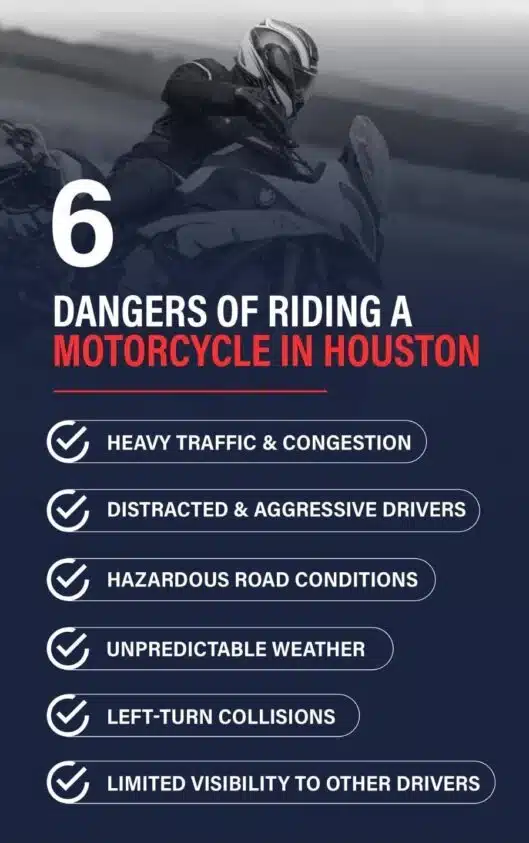
Houston traffic gives riders very little room for someone else’s mistake. Severe crashes frequently involve a driver who fails to detect the motorcycle or leaves the rider no safe escape path. Our separate guide explains the common causes of motorcycle accidents in Houston in more detail.
Drivers Turning Left in Front of Motorcycles
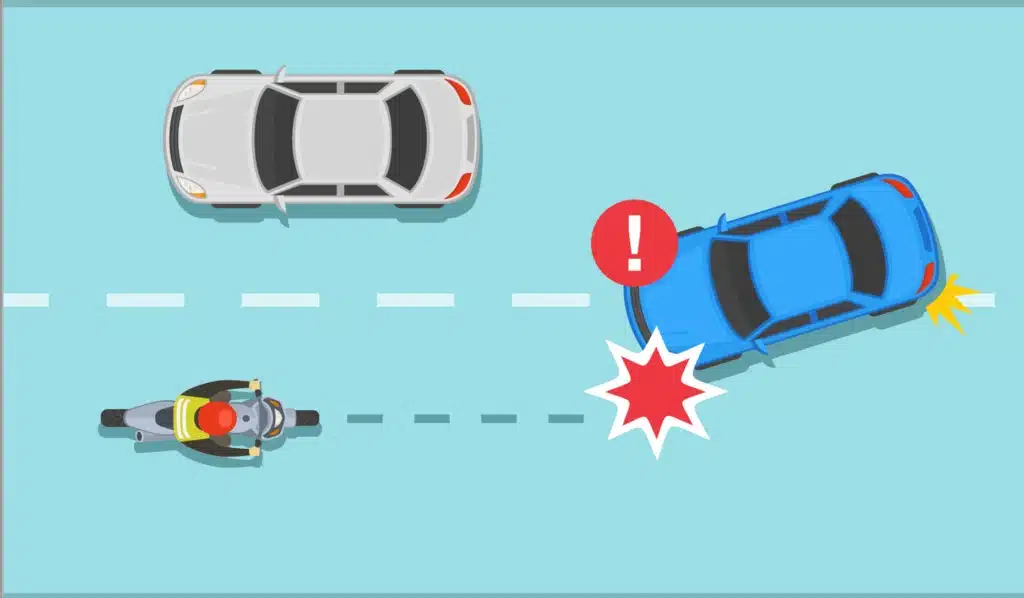
Left-turn collisions deserve careful investigation because the dispute is often predictable: the driver says the motorcycle was too far away or moving too fast. I want to know what the intersection, video, witness accounts, vehicle damage, and timing evidence actually show. “I did not see the motorcycle” may point to a lookout failure; it does not automatically excuse the turn.
Unsafe Lane Changes and Blind Spots
On I-45, I-10, Loop 610, Beltway 8, and Houston’s multilane roads, a sudden lane change can leave a rider with nowhere to go. Mirrors and blind spots matter, but so do turn signals, lane position, nearby traffic, video, and whether the driver actually checked before moving over.
Distracted, Speeding, and Impaired Drivers
Phone use, speeding, following too closely, and alcohol can make an ordinary traffic conflict into a catastrophic motorcycle crash. In the right case, phone records, toxicology evidence, vehicle data, receipts, witness testimony, or business records may become important.
Houston traffic gives riders very little room for error. Severe crashes frequently involve a driver who fails to detect the motorcycle or leaves the rider no safe escape path. Our separate guide explains the common causes of motorcycle accidents in Houston in more detail.
Drivers Turning Left in Front of Motorcycles
Left-turn collisions deserve careful investigation because the dispute is often predictable: the driver says the motorcycle was too far away or moving too fast. I want to know what the intersection, video, witness accounts, vehicle damage, and timing evidence actually show. “I did not see the motorcycle” may point to a lookout failure; it does not automatically excuse the turn.
Unsafe Lane Changes and Blind Spots
On I-45, I-10, Loop 610, Beltway 8, and Houston’s multilane roads, a sudden lane change can leave a rider with nowhere to go. Mirrors and blind spots matter, but so do turn signals, lane position, nearby traffic, video, and whether the driver actually checked before moving over.
Distracted, Speeding, and Impaired Drivers
Phone use, speeding, following too closely, and alcohol can make an ordinary traffic conflict into a catastrophic motorcycle crash. In the right case, phone records, toxicology evidence, vehicle data, receipts, witness testimony, or business records may become important.
When alcohol is involved, our Houston drunk driving accident lawyer page explains additional issues that may apply.
Proving Fault When the Insurance Company Blames the Rider
Texas uses proportionate responsibility. Under Texas Civil Practice and Remedies Code §33.001, a claimant generally cannot recover damages if the claimant is more than 50% responsible. If the claimant is 50% or less responsible, any recovery can be reduced by the percentage of responsibility assigned.
That rule gives insurers a reason to push blame toward the rider. Common arguments include speeding, lane position, lack of visibility, helmet use, or licensing. Those issues should be tied to actual causation and evidence. A defense theory is not proof simply because it appears in an adjuster’s letter.
For example, if a driver turns left across a rider’s path, whether the rider wore a helmet does not answer who caused the collision. Helmet use may become relevant to a head-injury damages question, but it should not be used to rewrite the basic crash mechanics.
What Compensation Can I Recover After a Houston Motorcycle Accident?
There is no reliable “average” settlement that can tell you what a serious motorcycle case is worth. The value depends on fault, injury severity, medical treatment, future care, work loss, permanent limitations, insurance coverage, and how well those losses can be proved.
Past and future medical expenses
Lost wages and reduced future earning capacity
Physical pain and mental anguish
Physical impairment and loss of normal activities
Disfigurement and scarring, including severe road rash
Motorcycle repair or replacement and other property loss
Funeral expenses and family losses in a fatal crash
For a fuller discussion of case-value factors, see our guide to the average motorcycle accident settlement in Texas. The point of that article is not to promise a number; it is to show what evidence tends to move the value of a claim.

What Injuries Are Common in Serious Motorcycle Accidents?
Motorcycles do not have a steel frame, airbags, or seat belts around the rider. Even when the rider survives, the injuries may affect work, mobility, independence, and family life for years.
- Traumatic brain injuries, concussions, and skull fractures
- Spinal cord injuries, paralysis, and serious back injuries
- Multiple fractures and orthopedic injuries requiring surgery
- Internal-organ damage and internal bleeding
- Amputation and crush injuries
- Severe road rash, infection, nerve damage, and permanent scarring
- Fatal injuries and wrongful death claims
A strong claim needs to address more than the bills already received. Depending on the injury, we may need medical opinions about future treatment, rehabilitation, home or vehicle changes, lost earning ability, long-term pain, and activities the client may no longer be able to do.
Where Serious Motorcycle Crashes Happen in Houston
Houston motorcycle crashes are not all the same. The road can change how a collision occurs and the evidence we look for.
- I-45 and I-10: High-speed traffic, abrupt braking, merging, lane changes, and freeway entrance or exit conflicts can make a driver’s small mistake catastrophic for a rider.
- Loop 610 and Beltway 8: Multiple lanes and frequent merging create blind-spot and lane-change disputes. Video and vehicle-position evidence can be important.
- Westheimer, FM 1960, and other major arterials: Large intersections, left turns, driveway entrances, and heavy cross-traffic create a different set of risks than freeway riding.
- Construction zones: Changing lane markings, barriers, uneven pavement, debris, and reduced sight distance can add an additional layer to the liability investigation.
TxDOT’s motorcycle-safety campaign reports that Texas recorded 557 motorcyclist deaths and 2,468 seriously injured riders in 2025. It additionally emphasizes intersections as a major danger point. See TxDOT’s motorcycle safety campaign for current statewide safety information.
Texas Motorcycle Laws That May Affect Your Claim
A motorcycle-law issue does not automatically decide an injury case. The better question is whether the conduct caused or contributed to the crash or the injuries. We keep this section short because these topics have dedicated guides.
Helmet Use
Texas Transportation Code §661.003 starts with a helmet requirement and provides an exception for certain riders and passengers age 21 or older who meet the statute’s requirements. Read our Texas motorcycle helmet law guide or review the official Texas helmet statute. Helmet use does not, by itself, determine who caused the crash.
Lane Splitting
Texas Transportation Code §545.0605 prohibits a civilian motorcycle operator from riding between lanes of traffic moving in the same direction or passing a vehicle while sharing that vehicle’s lane. Read our explanation of lane splitting in Texas or see the official Texas Transportation Code provision.
Motorcycle Licensing
Texas has specific Class M licensing requirements. The Texas Department of Public Safety’s motorcycle license page explains the current requirements. The defense may raise a licensing issue, but that does not automatically establish who caused the collision.
For a more extensive overview, see our 2026 guide to Texas motorcycle laws.
What to Do After a Houston Motorcycle Accident
Your health comes first. Take these steps when you can do so safely:
- Call 911 and request medical help. A motorcycle injury may be more serious than it first appears.
- Report the collision. Ask the investigating agency how to obtain the crash report.
- Photograph the scene. Capture the vehicles, motorcycle, road, debris, injuries, traffic controls, and surrounding businesses or homes that may have cameras.
- Get witness information. Names, phone numbers, and short notes about what each person saw can be important later.
- Preserve the motorcycle and gear. Do not authorize disposal or major repairs before the evidence is evaluated.
- Avoid recorded statements and rushed settlements. An early offer may not account for surgery, future care, or lost earning capacity.
- Speak with an experienced lawyer. Legal advice is most useful before evidence disappears or the insurer obtains a statement that can be used against you.
See our full checklist on what to do after a motorcycle accident.
How Much Does a Houston Motorcycle Accident Lawyer Cost?
Baumgartner Law Firm handles accepted motorcycle injury cases on a contingency fee. You do not pay an attorney fee up front. The fee is a percentage of the recovery and is explained in the written agreement. If the firm does not recover compensation, you do not owe an attorney fee.
Read more about the cost of hiring a motorcycle accident attorney, including fees and case expenses.
Baumgartner Law Firm
Call an Award-Winning Motorcycle Accident
Attorney in Houston for Help
Attorney in Houston for Help
Talk with a top-rated Motorcycle accident lawyer by calling (281) 587-1111
Fill out an online consultation request for a FREE consultation.
How Long Does a Motorcycle Accident Case Take?
There is no single timetable. A claim should not usually settle until the medical condition and future needs are clear enough to value the loss. Some claims resolve within months after treatment ends. Serious injury, disputed fault, several defendants, limited insurance, liens, or litigation can extend the case for a year or longer.
Filing a lawsuit does not mean the case will go to trial. Many cases settle after the parties exchange evidence, take depositions, and understand the risks. We recommend the path that best protects the client rather than pushing every case toward a quick settlement or an unnecessary trial.
Motorcycle accident guides
What it costs to hire a motorcycle accident attorneyMulti-rider settlement divisionTexas motorcycle accident trendsFatal motorcycle accidents in HoustonTexas motorcycle permit restrictionsTexas moped lawsThe dangers of riding in HoustonMotorcycle Awareness Month in TexasWho is responsible for ATV accidents?
Communities we serve
Related practice areas

Frequently Asked Questions
Who is usually at fault when a car turns left in front of a motorcycle?
The turning driver may be at fault if they fail to yield to an approaching motorcycle, but fault depends on the evidence. Video, sight distance, signal timing, impact location, speed evidence, and witness accounts may all matter.
Can an insurance company blame me just because I was riding a motorcycle?
An insurer can argue that a rider shares fault, but it still needs evidence. Speed, lane position, visibility, and other facts should be tied to the actual cause of the crash rather than to stereotypes about motorcyclists.
What if the driver says they never saw my motorcycle?
“I never saw the motorcycle” does not end the fault analysis. It can raise questions about lookout, visibility, right-of-way, sight distance, distraction, and whether the driver checked for traffic before turning or changing lanes.
Should I let the insurance company take or repair my motorcycle?
Preserve important evidence for documentation in a serious injury or disputed case. The motorcycle and damaged components may help explain impact direction, force, vehicle contact, or a mechanical issue. Photographing or inspecting the bike first may be important.
Can I recover compensation if I was partly at fault?
Yes, in many cases. Texas generally allows recovery when the injured person is 50% or less responsible, but compensation is reduced by that percentage. A rider who is more than 50% responsible generally cannot recover damages.
Will not wearing a helmet destroy my case?
No. Helmet use does not decide who caused the crash. It may affect a head-injury damages argument if the defense can prove that a helmet would have prevented or reduced the injury. It should not reduce compensation for injuries a helmet could not have prevented.
What if the driver had little or no insurance?
Other sources may include uninsured or underinsured motorist coverage, a commercial policy, an employer’s policy, an umbrella policy, or another party involved in the crash. Coverage should be investigated before the claim is valued.
Will my motorcycle accident case go to court?
Many claims settle without a trial. A lawsuit may still be necessary to obtain evidence, protect the deadline, or advance negotiations. If litigation becomes necessary, the firm handles the filings, discovery, depositions, expert work, and trial preparation.
How Long Do I Have to File a Texas Motorcycle Accident Lawsuit?
The general Texas personal-injury limitations period is two years under Texas Civil Practice and Remedies Code §16.003. Exceptions, legal disabilities, claims involving governmental entities, and special notice rules may change the deadline. Speak with a lawyer promptly rather than relying only on the general rule.
testimonials
Here’s What Our Motorcycle Accident Clients are Saying
“DEDICATED TO HELPING HIS CLIENTS AND GOING THE EXTRA MILE TO GET THINGS DONE”
He is an attorney that is dedicated to helping his clients and going the extra mile to get things done. I would not hesitate to use him again and he is the only attorney that our family will use in the future. I honestly could not ever imagine such a great experience coming out of such an awful accident.
R. Alcorn
“I WOULD 100% RECOMMEND THE BAUMGARTNER LAW FIRM”
I would 100% recommend the Baumgartner Law Firm to any friends and family who not only wanted to the best outcome but wanted a lawyer who listened and upheld the integrity of Law and client to attorney relationship.
S. Arnold
“BEST ATTORNEY IN THE WORLD!!!!!”
Best Attorney in the World!!!!! I did not have a very high opinion of attorneys until I met Greg Baumgartner. He is the most decent and honest attorney I have ever dealt with.
K. Kaiyune

Houston Motorcycle Accident Resources
For more detail on specific motorcycle issues, these guides may help:
Speak Directly With Greg Baumgartner
A serious motorcycle case deserves prompt investigation and personal attention. If you were badly hurt or lost someone you love in a Houston motorcycle crash, call Baumgartner Law Firm at (281) 587-1111 or request a free, confidential consultation. I will listen to what happened, explain whether we can help, and tell you what I believe should happen next.
Baumgartner Law Firm
6711 Cypress Creek Parkway
Houston, Texas 77069
No attorney fee unless we recover compensation for you.
NEED HELP? HAVE QUESTIONS?
"*" indicates required fields
We will answer you within 24 hours via email, or you can call us directly for immediate help!