If you spend any time on Houston’s freeways, you’ve probably seen it: bumper-to-bumper traffic where drivers are practically inches apart, each one hoping nothing goes wrong. Unfortunately, things do go wrong — and following too closely is one of the most preventable causes of rear-end accidents on Texas roads. So what is the safe distance between cars at highway speeds, and what does Texas law actually require? Here’s a guide by a Houston car accident attorney that every driver should know.
A rear-end collision does not automatically establish who was at fault. If you were injured because another driver followed too closely, our guide to legal options after a Houston car crash explains how fault, insurance, and injury claims are evaluated.
What Texas Law Says About Following Distance
Texas law requires drivers to maintain an “assured clear distance” between their vehicle and the one ahead. Under Texas Transportation Code § 545.062, you must leave enough space to stop safely if the vehicle ahead brakes suddenly. This applies at any speed and in any traffic condition.
What the law doesn’t do is specify a number of feet. That ambiguity has real consequences: courts in Texas generally do not treat a violation of the assured clear distance rule as automatic negligence in a civil case. That said, if you rear-end someone, you’ll have a very hard time explaining why the collision wasn’t your fault.
The Rules of Thumb Drivers Actually Use
Since the law doesn’t spell out a precise distance, safety experts and the Texas Driver Handbook offer practical guidelines. Here are the two most widely used:
The 3-Second Rule (Recommended for Highway Speeds)
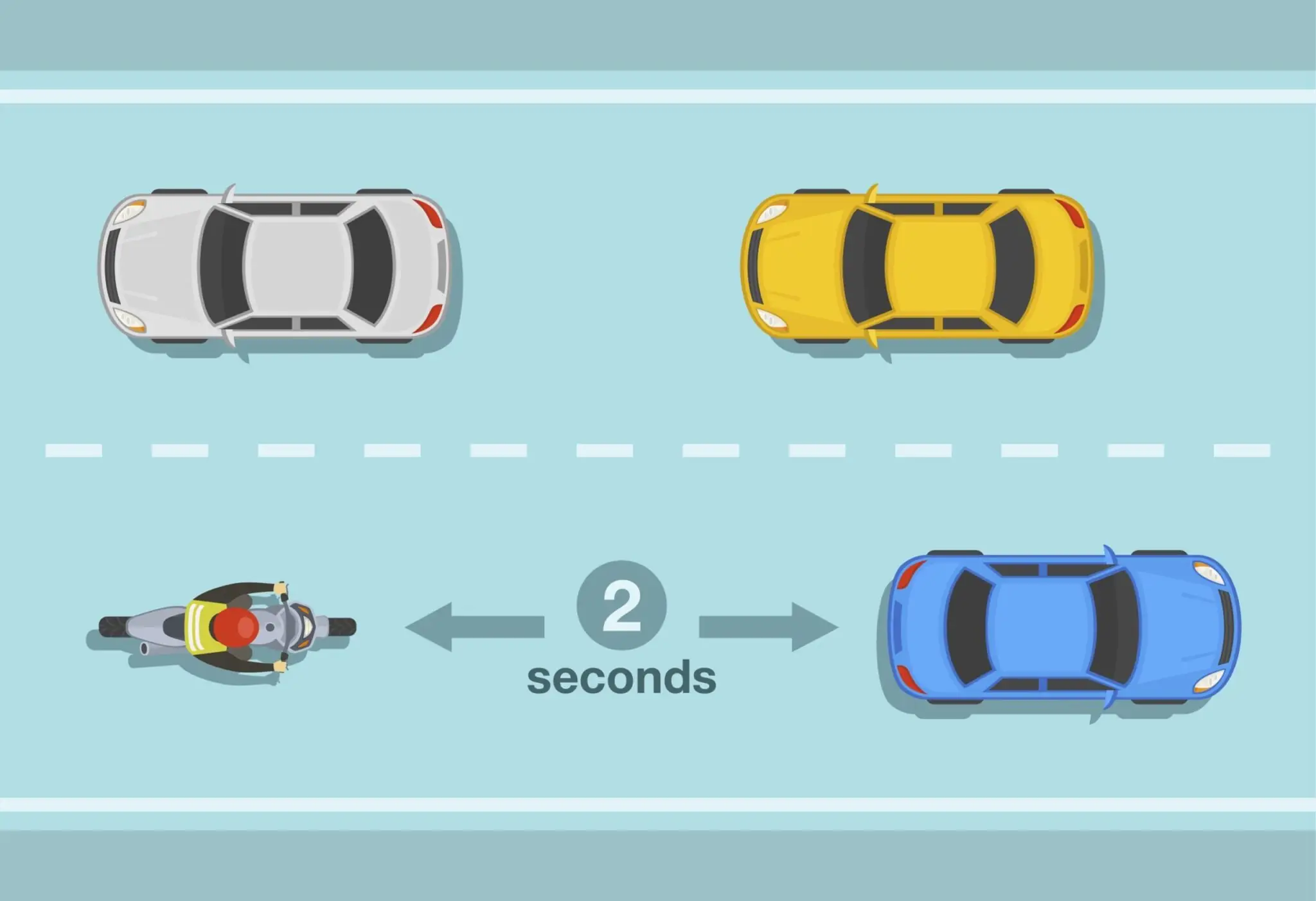
Pick a fixed object on the side of the road — a sign, an overpass, a mile marker. When the car ahead passes it, count slowly: one-thousand-one, one-thousand-two, one-thousand-three. If you pass the same object before you finish counting, you’re following too closely.
The Texas Driver Handbook recommends the 2-second rule at 30 mph and the 3-second rule at higher speeds. Research on driver reaction times shows that it takes an average of about 1.5 seconds to respond in an emergency — which means a 3-second gap is the minimum, not the ideal.
To put it in concrete terms:
- At 50 mph, a 3-second following distance equals roughly 229 feet
- At 70 mph, that gap expands to approximately 387 feet
Those are long distances — far longer than most drivers leave. Next time you’re on I-10 or the 610 Loop, count it out.
The Car-Length Rule
You may have heard the advice to keep one car length for every 10 mph. At 70 mph, that’s seven car lengths. It’s a useful mental image, but it has an obvious flaw: car lengths aren’t uniform. An F-250 and a Honda Civic are not the same length. For that reason, the seconds-based rule is generally more reliable.
The Tire-Bottom Check
Here’s a quick visual check: if you can’t see the bottom of the tires on the vehicle in front of you, you’re too close. It’s not a substitute for the 3-second rule, but it’s a fast gut check that requires no counting.
When to Increase Your Following Distance
Three seconds is a floor, not a ceiling. There are several situations where you should be giving yourself significantly more room:
Bad Weather
Rain, fog, ice, or any condition that reduces visibility or traction should prompt you to double your following distance to at least 6 seconds. Wet pavement dramatically increases stopping distances, and Texas roads can become unexpectedly slick after a dry spell, when oil and other residues rise to the surface during the first rainfall.
18-Wheelers and Big Rigs
If you’re driving behind — or being followed by — a tractor-trailer or 18-wheeler, the stakes are higher. A fully loaded semi-truck takes roughly one-third longer to stop than a passenger car at highway speeds. That’s not just a guideline; it’s physics. And that assumes the truck’s brakes are properly maintained. Brake failures and other mechanical problems are a leading cause of serious truck accidents in Texas.
If a big rig is riding close behind you in heavy traffic, move to another lane when it’s safe to do so. Don’t brake-check it. Give it room.
Worn Brakes or Tires
Your vehicle’s condition affects how long it takes to stop. If your brakes are wearing thin or your tires don’t have much tread left, treat the 3-second rule as an absolute minimum and add extra cushion. The rules assume your car is in reasonable working order.
What to Do When Someone Is Tailgating You
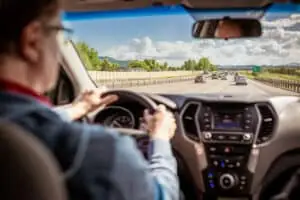
Tailgating is one of the most common and most frustrating driving behaviors on Houston highways. It’s also one of the main reasons rear-end collisions are so common on Texas roads. If someone is following you too closely:
- Stay calm. Reacting aggressively or brake-checking can escalate a bad situation into a dangerous one and could expose you to liability.
- Ease off the gas gradually to increase the gap between you and the car ahead. This gives the tailgater more reaction time if traffic slows.
- Change lanes when it’s safe to do so. Let faster drivers pass and move to a lane that matches your speed.
- Do not try to “teach them a lesson.” Road rage incidents in Texas can and do turn fatal.
The goal is always to arrive safely. Let the aggressive driver be someone else’s problem.
Why This Matters More on Texas Highways Than City Streets
It might seem counterintuitive, but highway driving poses serious risks. Without stoplights, intersections, or pedestrians, drivers often let their guard down. The reality is that highway accidents in Texas tend to be more severe when they do happen, simply because of the speeds involved. A collision at 70 mph is not the same as one at 35 mph.
Texas has some of the most dangerous highways in the country. If you want to understand the scope of the problem, the statistics behind the deadliest highways in Texas are sobering.
Speeding compounds following-distance problems. The faster you’re going, the longer your stopping distance and the shorter your reaction window. A speeding-car accident lawyer can help after a crash injury.
Quick Reference: Safe Following Distance by Speed
Here’s a simple summary of recommended following distances under normal conditions:
- 30 mph — 2-second rule (approximately 88 feet)
- 50 mph — 3-second rule (approximately 229 feet)
- 70 mph — 3-second rule (approximately 387 feet)
- Any speed in rain, ice, or fog — 6-second rule minimum
- Any speed when following or being followed by an 18-wheeler — add additional distance beyond the standard rule
These are minimums. There’s no penalty for leaving more room.
Injured by a Driver Who Was Following Too Closely? Here’s What to Know.
If another driver rear-ended you because they were following too closely, you may be entitled to compensation. Texas is an at-fault state, which means the driver responsible for the accident is generally liable for the harm they caused. A Houston car accident attorney can review the circumstances of your crash and help you understand what your claim may be worth.
Depending on the facts, recoverable damages in a rear-end accident case can include:
- Medical expenses, both current and future
- Lost income and reduced earning capacity
- Vehicle repair or replacement costs
- Pain, suffering, and diminished quality of life
At Baumgartner Law Firm, our Houston injury lawyers deliberately limit their caseload — because we believe every client deserves real attention, not a file number. Attorney Greg Baumgartner has been handling serious injury cases in Houston since 1985, and the firm operates on a contingency fee basis, meaning you pay nothing unless we recover compensation for you.
Call us at (281) 587-1111 or contact us online to schedule a free consultation.
6711 Cypress Creek Pkwy
Houston, TX, 77069
Schedule a FREE Case Consultation Now!