
How to Prove Wrongful Death in Texas
Evidence, legal elements, causation, and proof of the family’s loss
Written and legally reviewed by Greg Baumgartner, Houston personal injury attorney | Founder and lead trial lawyer | 40+ years of experience | Updated August 14, 2026
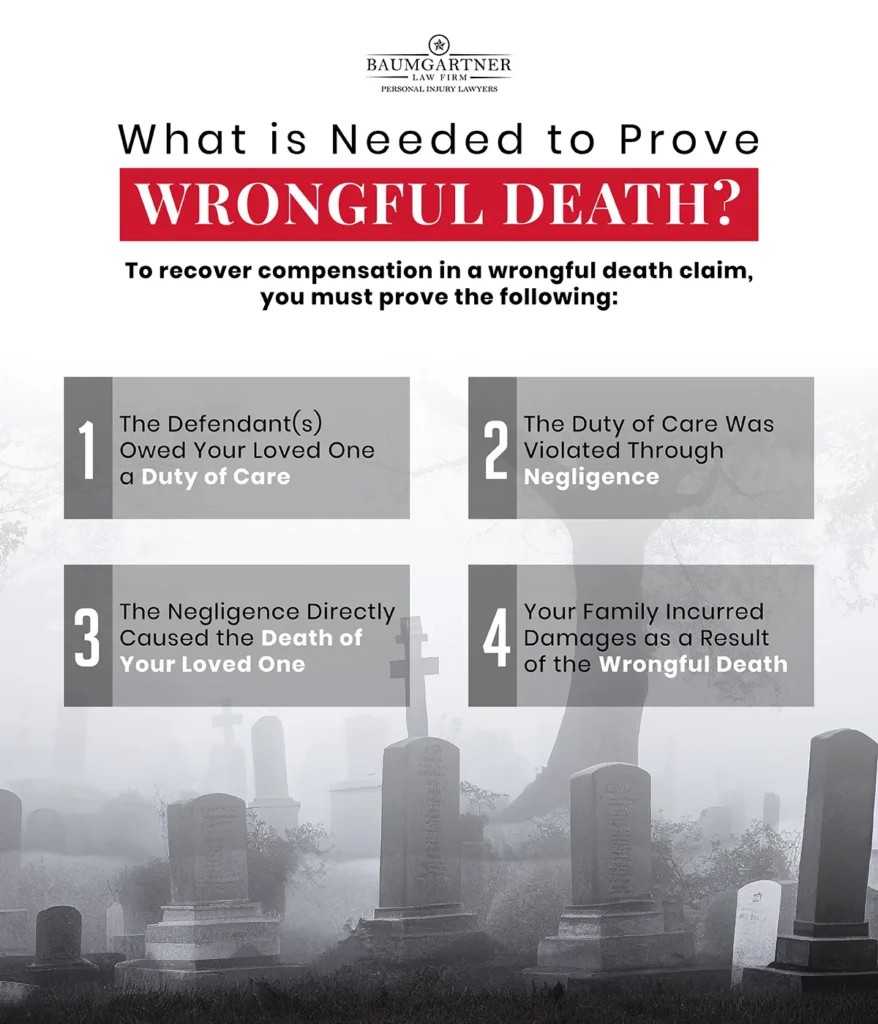
To prove a negligence-based wrongful death claim in Texas, the family must show four things: a legal duty, a breach of that duty, proximate cause, and damages. The proof must make each required fact more likely to be true than not true. A police report can help, but it is rarely enough on its own.
I am Greg Baumgartner. I have handled serious injury and fatal accident cases for more than 40 years. The first proof question is not, “Who should we sue?” It is, “What evidence will show why this happened?” In a fatal case, the person who died cannot explain what he or she saw. Independent proof often carries more weight than either side’s story.
If your family needs legal help after a fatal accident, know that I have handled Houston wrongful death cases since 1985.
Quick answer: A strong wrongful death case connects each legal element to reliable evidence. It also separates the family’s losses from any claims belonging to the deceased person’s estate.
What Must Be Proven in a Texas Wrongful Death Case?
Under Texas Civil Practice and Remedies Code §71.002, a wrongful death claim may exist when an injury causes a death. The claim must also show that the person or company would have been liable if the injured person had lived. The proof will depend on the type of case. A bad-driving case, for example, is not proven in the same way as a failed-product or unsafe-worksite case.
Most fatal accident claims are based on negligence. In those cases, the family generally must prove the following four elements:
Element | What must be shown | Evidence that may help |
Duty | The defendant had a legal responsibility to act with reasonable care. | Traffic laws, contracts, ownership records, control documents, safety rules, and company policies. |
Breach | The defendant did something unsafe or failed to exercise reasonable care. | Video, photographs, vehicle or device data, inspection records, work records, and witness statements. |
Proximate cause | The breach was a major cause of the fatal injury, and the harm could be foreseen. | Scene photos, crash review, medical records, autopsy results, lab tests, and expert work. |
Damages | The death caused losses recognized by Texas law. | Family accounts, photos, messages, calendars, pay and benefit records, bills, and loss estimates. |
The Four Elements to Prove Wrongful Death Claims in Texas
The Police Report Is a Starting Point, Not the Final Word
A police or incident report may identify witnesses, show the first statements made, and record visible facts. It can also be incomplete or wrong. The officer may not have seen the event. Important video or electronic data may not be available when the report is written. A company may possess records the investigating officer never requested.
I begin with the report, but I do not let it set the limits of the investigation. The job is to test each conclusion against the physical evidence, electronic records, medical findings, and neutral witnesses.
Evidence That Can Prove Fault and Cause
Physical and scene evidence
Photographs, skid marks, vehicle damage, broken equipment, road conditions, guardrails, lighting, warning signs, and the layout of a worksite can show how the event happened. An early inspection may reveal facts that disappear after repairs or cleanup.
Electronic and company records
Vehicles, phones, cameras, trucks, machines, and entry systems may create digital records. A business may also have driver files, training records, inspection reports, repair logs, schedules, contracts, safety rules, or earlier complaints. These records can show both the final mistake and the choices that created the danger.
Medical and cause-of-death evidence
Medical records may help link the event to the death. So may the death certificate, autopsy results, lab tests, scans, and testimony from the treating doctor. A death certificate states a medical cause of death. It does not decide who is legally at fault.
Independent witnesses
Neutral witnesses often become especially important when the deceased person cannot give an account. Witnesses should be identified and interviewed while their memories are fresh. Their exact words matter more than a short summary written months later.
Important Evidence Can Disappear Quickly
A family may need time before it is ready to think about a legal claim. Evidence does not wait. Business video may be overwritten. A vehicle may be repaired or sold. A jobsite may change within hours. Electronic records may be deleted under a routine retention policy.
A preservation notice tells a person or company to keep named evidence. The next steps depend on the case. They may include inspecting a vehicle or machine, saving digital data, taking scene photos, finding witnesses, and asking for records before they are lost.
Greg Baumgartner’s approach: After a fatal accident, I ask one question early: What evidence will be gone in thirty days if no one acts now? That question often shapes the first part of the investigation.
Proving Causation When the Defense Blames Something Else
A defendant may admit that a mistake occurred but deny that the mistake caused the death. The defense may point to a medical condition, another driver, a different contractor, or the conduct of the person who died.
Texas law looks at two parts of proximate cause: actual cause and foreseeability. The careless act need not be the only cause or the last event before the death. It must play a major part in causing the harm, and that harm must have been reasonably foreseeable. The Texas Supreme Court explained these rules in Windrum v. Kareh.
The defense may also try to assign some fault to the deceased. Under Texas Civil Practice and Remedies Code §33.001, Texas law may cut an award based on the deceased person’s share of fault. It may bar recovery if that share exceeds 50 percent. This makes independent proof vital. The person who died cannot answer an unfair charge.
Call an UNDEFEATED wrongful death LAWYER IN HOUSTON FOR HELP!
Does Every Wrongful Death Case Need an Expert?
No. Some cases can be proven with physical evidence, records, and ordinary witness testimony. Experts become more important when the subject is outside a juror’s common knowledge or when the defense raises a technical cause.
- A crash expert may study vehicle movement, impact points, speed, and crash data.
- An engineer may study a failed product, machine, road feature, or building condition.
- A safety expert may explain trucking, construction, workplace, or company rules.
- A doctor or pathologist may explain how the injury caused the death and address claims about another cause.
- A financial expert may estimate lost support, services, job benefits, and inheritance.
The expert’s title is not enough. A useful opinion must connect the facts to the conclusion and explain the reasoning in plain language.
Proving the Full Family Loss
A wrongful death case has two different narratives of proof. The first explains how the death happened and who is responsible. The second shows what each eligible family member lost.
Financial records can show lost income, benefits, household services, and likely inheritance. Those numbers matter, but they are not the whole case. Family accounts, photos, videos, messages, calendars, and school records can also help. So can the words of people who knew the family well. Together, this proof may show the loss of companionship, care, advice, guidance, and support.
I do not believe a family’s grief should be turned into a sales phrase or a formula. The goal is to present the relationship honestly and specifically. A spouse, child, or parent should be seen as an individual experiencing a loss, not as a name on a claim form.
A related survival claim is different. It belongs to the estate and focuses on losses the deceased person experienced before death. Keeping claims and proof separate helps prevent important damages from being overlooked or miscategorized.
Common Proof Problems in Fatal Accident Cases
- Waiting until video, electronic data, or physical evidence has disappeared.
- Treating the police report as the final decision about fault.
- Looking only at the person who made the last mistake and missing a responsible company, employer, contractor, owner, or manufacturer.
- Assuming a death certificate proves legal responsibility rather than the medical cause of death.
- Waiting for a criminal case to end before protecting the family’s separate civil claim.
- Using general statements about grief instead of evidence showing each family member’s actual relationship and loss.
Frequently Asked Questions
Who has the burden of proof?
The person bringing the wrongful death claim has the burden of proving each required element. In most civil cases, the standard is a preponderance of the evidence, meaning more likely than not.
Can a wrongful death case be proven without an eyewitness?
Yes. Physical evidence, video, electronic data, company records, medical findings, and circumstantial evidence may prove what happened even when no one saw the entire event.
Is a criminal conviction required?
No. A civil wrongful death case is separate from a criminal prosecution. The civil claim can proceed even when no criminal charge is filed or when the defendant is found not guilty.
Must the defendant’s negligence be the only cause of death?
No. An injury may have more than one proximate cause. The evidence must show that the defendant’s conduct was a substantial and foreseeable cause of the fatal harm.
How soon should evidence be protected?
As soon as reasonably possible. The legal filing deadline may be measured in years, but useful evidence can disappear within days or weeks.
Related Wrongful Death Resources
- How to File a Wrongful Death Lawsuit in Texas — A clear guide to the claim, investigation, filing, discovery, settlement, and trial.
- Who Can Bring a Texas Wrongful Death Claim? — A guide to eligible spouses, children, parents, adopted family members, and the estate representative’s role.
- Texas Survival Actions Explained — How an estate may pursue the personal injury claim the deceased person could have brought if he or she had lived.
- Texas Wrongful Death Filing Deadlines — The general two-year limitations period, possible exceptions, and shorter notice rules that may apply.
Speak Directly With Greg Baumgartner
If your family lost someone because of another person’s carelessness or a company’s unsafe conduct, you do not need to know every legal answer before calling. I will listen to what happened, explain what evidence may matter, and tell you what should be protected first.
Call Baumgartner Law Firm at (281) 587-1111 for a free, confidential consultation. I personally handle the wrongful death matters the firm accepts. There is no attorney fee unless we recover compensation for your family.
For a FREE Consultation Contact Us Today
Our Experienced Houston Personal Injury Lawyer Can Help!
For a Free Consultation with a Preeminent Rated Injury Lawyer
Case Results
$5,750,000.00 Truck Accident - Wrongful Death
We represented a truck driver who lost control of his rig and jackknifed across the roadway, killing two innocent victims. We obtained more money for the death of the truck driver who caused the accident than the other “truck accident lawyers” got for the families of the innocent victims killed by the truck driver in the accident.
$6,000,000.00 Daycare Injury
We represented a young child injured at a daycare center. The case was settled before trial for millions above the daycare liability policy.
Confidential Settlement Commercial Vehicle Crash - Wrongful Death
Commercial vehicle accident in which we uncovered numerous violations of the trucking regulations. The trucking company required a confidential settlement so others would not know how much they had to pay us.
Confidential Settlement Burn Injury
Our client was burned in a house fire. The insurance company denied any responsibility. But they paid our full demand after filing a lawsuit and before trial.
Confidential Settlement 18-Wheeler Accident - Wrongful Death
Wrongful death case involving an 18-wheeler. The trucking company disputed liability. Yet, the insurance companies were forced to pay us the highest damages ever for the trucking company.
About Our Law Firm in Houston
Greg Baumgartner heads the Baumgartner Law Firm.
Our firm was established in 1985 and has helped thousands of injury victims get maximum compensation for their cases. If you have been injured in an accident in Houston, TX, contact us for a free, no-obligation consultation. (281) 587-1111.
Baumgartner Law Firm has limited our law practice to serious personal injury cases. Our legal team has won maximum compensation for thousands of accident victims and recovered millions of dollars for real people like you.
testimonials
Client Reviews
Mayra T
Houston Personal Injury Victim
Mr. Greg is a great personal injury lawyer. Looking for the best help? Call Baumgartner Law Firm!
Brian Wilson
Houston Personal Injury Victim
I highly recommend this law office. Greg Baumgartner is knowledgeable, dependable, honest and truly has the client’s best interests at heart.
Callie M
Houston Personal Injury Victim
Greg, a personal Injury Lawyer at Baumgartner Law Firm represented me in my personal injury case. I am very happy with the case result. Baumgartner is a GREAT law firm with GREAT people. They get RESULTS.
Cindy S
Houston Personal Injury Victim
My experience with Baumgartner law firm was excellent. They took the time to hear my concerns and kept me informed throughout the process. They fought for the best resolution for my case. Working with Greg and Lissa gave me peace of mind in a scary and stressful situation. I highly recommend their services.
Mr. Greg is a great personal injury lawyer. Looking for the best help? Call Baumgartner Law Firm!
Mayra T
Houston Personal Injury Victim
I highly recommend this law office. Greg Baumgartner is knowledgeable, dependable, honest, and truly has the client's best interests at heart.
Brian Wilson
Houston Personal Injury Victim
Greg, a personal Injury Lawyer at Baumgartner Law Firm represented me in my personal injury case. I am very happy with the case result. Baumgartner is a GREAT law firm with GREAT people. They get RESULTS.
Callie M
Houston Personal Injury Victim
My experience with Baumgartner law firm was excellent. They took the time to hear my concerns and kept me informed throughout the process. They fought for the best resolution for my case. Working with Greg and Lissa gave me peace of mind in a scary and stressful situation. I highly recommend their services.
Cindy S
Houston Personal Injury Victim
NEED HELP? HAVE QUESTIONS?